Ardour already uses rubberband for stretching audio content.
1 Like
Then I misunderstood your reply earlier. Nevermind, this is most likely not the right topic, as the audio manipulation interfaces seems to be out of scope for this update and the stuff listed in the original post is already ambitious.
There are different SDKs for stretching audio content. Rubberband is the free/open-source one, Ardour already uses it. Elastique, which is typically used in proprietary software and arguably provides better results, is a non-free one. It’s currently unavailable for Ardour for reasons I don’t think I’m at liberty to mention.
1 Like
In Linux, try GSnap or x42 Autotune or MLTune and see if they’re useful for your pitch correction needs.
For time stretching, try Ardour’s built in tools and see how you get on - it’s easy and right there in the toolbar (shortcut T).
3 Likes
Thanks. I’m gonna try, but, i’m pretty sure your’re talking about auto-tune style plug-ins.
My needs are more like in detail and non-auto pitch correction, basically, correction that will be unnoticeable if done with care and precision. Things like Nectar, Melodyne, WavesTune, VariAudio…
And yes, i already tried time-streching in ardour and it definitely works for some things…other stuff, not realy. It’s tricky to say to the artist in this day and age “You know, your timing on this 2 second part (that’s repeated throughout the hole song) is all over the place…if you want it to sound atmospheric, hypnotic and repetitive i think you should practice it for couple of months with metronome and then we’ll try to re-record it, no guarantees.” (that would be the real truth  ) .
) .
But yes, i agree, this is not the topic for this occasion. As someone already said, new features are great and already ambitious enough.
Yeah… This is why I moved few months ago from Ardour to Studio One even if it has no 3rd party plugin GUI support… But I will be back if only this feature is implemented. This and proper comping.
But take look at Reaper, you can set stretch mode to “Rubber band library” in a clip properties and still use the markers directly on the track, not in a separate window:
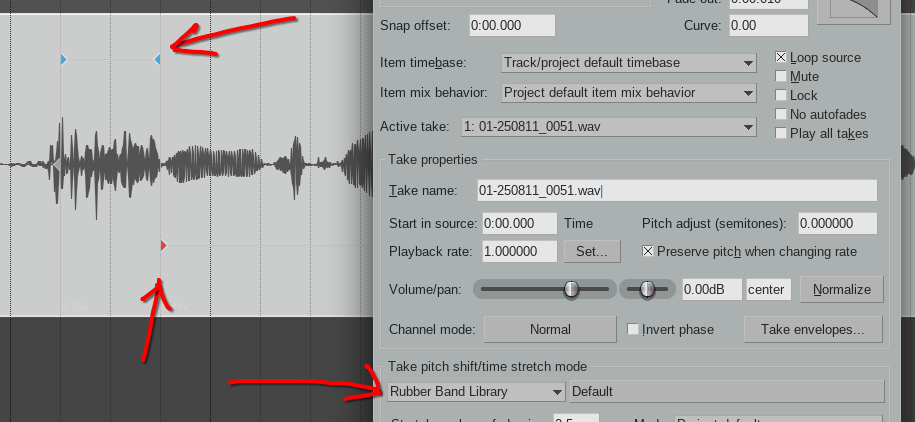
BTW. Use of markers to bend audio is a way better if you can manipulate them directly on track and not (only) in separate edit window (Bitwig like). This way you can align multiple tracks together which is very important.
Best regards!
Skygge
5 Likes
That looks like a well thought-out workflow indeed
3 Likes
This would be on version 1.4.7 of PipeWire, the latest version.
And Robin, for your question on the ALSA side of things, I was using the ALSA plugin with PipeWire (called pipewire-alsa on CachyOS or Arch), and I think it’s more of a regular PipeWire thing. For clarification, I got rid of almost everything Pipewire (except libpipewire) to see if that segfault occurs. That is the same thing I was talking about, the exact segfault I posted about a month or two ago.
The ardour ALSA backend only accesses hardware devices, not virtual ALSA devices. Either you were not using the ALSA backend, or you are confused about which device you were using. When using the Ardour ALSA backend Pipewire will release exclusive access of the hardware device so that Ardour can open the device for exclusive access.
Unless the Pipewire-ALSA module lies about its hardware status
Just checked out the nightly. The lower pane looks very promising to bring effect racks in some future version! Really hope this is going to happen someday. 
Very nice to have all those options to change regions in there and RegionFX is amazing!
Can’t wait to see how ardour 9 will be when its released! You guys do amazing work! Keep it up!
1 Like
I agree, the pane looks very promising. I can’t wait to see how it will work in the final version. But for now, it looks like a project in its early stages. You cannot resize this pane, change plugins order, MIDI editor has some bugs - if you edit velocity and press for example pitch bender, the lower pane gets stuck so you can’t uncheck any of them. Can’t wait for the final version, but there is still a lot to do.  This is certainly a step in the right direction.
There are currently no plans to make it resizable for the Editor. Eventually it should be a fixed height when visible, regardless of content.
When you hide the editor/mixer (Shift +E), a small processor box shows up in the bottom pane which allows one to re-order plugins. Dragging the Fx boxes themselves is not really an option since only processors with controls show up there.
I expect a lot of the detailed work (allow a user to pick which controls of a plugin to show at the top) will come after 9.0; the bigger remaining issues are indeed MIDI pianoroll related.
4 Likes
I’m surprised to see that there’s still no mention of ARA support on this list.
ARA support is not planned for 9.0. It may or may not happen, but since it’s only relevant for very few plugins it is not very high priority.
I don’t think it’s about how many plugins the feature is actually available for but rather, the importance of the function the feature performs if it were supported. Manual pitch correction eg Melodyne cannot be overlooked in this day and age. So also are the usefulness of the other plugins that need this feature to integrate more seamlessly.
Before anybody replies to me talking about how good and perfect recordings were made in the history of music before the advent of this technology, I’d like to ask any such person this question…why do you make music on a computer? Because historically speaking, some if not most of the greatest songs in history were made on tape desks and/or consoles. No computers involved and by your own logic, that’s exactly what you’re supposed to still be using. If you’re not doing that, then you should please not mention music history to me here on this topic.
1 Like
This is incorrect and/or wrong.
Surely, it would be wrong or incorrect because it opposes your point of view. However, Bob Marley’s albums were not recorded on computers, Jimmy Reeves albums was not recorded on computers, Boney M albums were not recorded on computers, The Jackson Five albums were not recorded on computers, ABBA albums were not recorded on computers, Jimmy Hendrix and also, The Beatles were not recorded on computers and the list goes on.
So, having these as reference points, which part of my statement is wrong or incorrect? Is it the part that they were not recorded on computers, or are you saying they were or are not great recordings in music history? Please clarify as I’d love to learn from you.
What matters about the tape/console workflow is the workflow, not the technology. You can still do that workflow with computers if you wish, or you use very different workflows. It’s not computers vs. tape+desk, it’s “record great performances” versus “create music bit by bit, which might (or might not) end up as great”. Both are valid, but that’s the tension, not the underlying technologies being used.
7 Likes