The hard part of this work was refactoring the code that was originally intended to be used in the context of the entire Editor “canvas” display so that it could be used anywhere, any number of times, at any size/scale.
How step entry works is not really related to that.
Cool, dedicated PianoRoll and RTA .
I’m not ashamed to admit that i did and still do use Cubase (old habbits die hard), so a dedicated pianoroll feels like home to me. I was always annoyed when working with midi in Ardour, mainly cause of this (and velocity lolipops, which are already added).
Now we only need handy time-stretching & pitch-shifting with the highest posible algorithm quality, and bunch of drum related pristine recorded big sample librarys - not a lot to ask for .
I’m aware of how Paul feels about theese tools (like, for example, i also hate when i can hear any glimpse of auto-tune sound) but being able to correct something that i missed during recording of performance when the artist is long gone from studio, or sometimes when you realise that some instrument is partialy slightly of is a really good option.
But hey, these new features are also great, didn’t mean to be a drag.
That is something you can use a plugin for, and there are various ones out there.
Seeing as this is unrelated to DAW development, this is something that any musician or producer could contribute. Neither paul nor me are sufficiently competent in that field. Ardour already has a library manager for samples and clips. Making more available would be trivial once someone provides them.
This is fantastic and all, but is that Pipewire bug I showed part of the bug fixes? I want to be able to do MIDI work on it again soon (and keep Zrythm, which I have to use right now, for archival of a different project or two).
Can you clarify what you mean? I looked through your older posts, and all I found was a report of seg fault that you said was also duplicated with the ALSA backend, so I wouldn’t call that a “pipewire bug.”
It is also the clearly stated policy that only Pipewire/JACK backend bugs which are duplicated using jackd, i.e. shown to be a true Ardour error and not a pipewire regression, will be addressed.
It is that segfault while using PipeWire. While I attempted to use ALSA, the same thing happened because of the PipeWire backend. I still can’t do MIDI work with Ardour right now, and getting rid of PipeWire might do me more harm than good at the moment (I’m on CachyOS).
In Windows, yes. In Linux, not realy or i’m simply not aware of those plug-ins (and i use win and lin, with plan to completely migrate to lin cause win simply pisses me of with they’re “everything must be in a could” kind of thinking. That system simply annoys me. If you have tools, you want em in your tool box, avilable any time, not in some rental garage storage in another city.
In Windows you’ve got things like Melodyne or Nectar.
In Linux you could use those functions in Reaper then transfer that newly printed tracks back to Ardour. But that means using 2 daw’s, and creating 2 generations of track. Also, some small things you only notice when you’re at the end of mixing, and when you can hear how all tracks relate to each other.
People said it here before, time-stretching&pitch-shifting is mostly included in today’s daw’s, and i would also like to suggest that’s a good idea - PT, Cubase, Reaper, Tracktion (don’t know about Ableton & BitWig, never actualy used them)…
And also there’s this thing about plug-ins, if plan to recall your projects flawlesly few years after you initaly created them, and do some alterations…
Softwre versions change, therms of use change, OS dependency change etc and it all breaks backwards compatibility in some small way or even completely…
My personal wish/idea/goal is to have a setup that is kinda future-proof to be able to recall projects any time i want. So, that’s why i’m realy bothered with “outsourcing” time-stretching and pitch-shifting.
AFAIK cubase and reaper are using elastique for the audio editor pitch manipulation and time stretching.
Reaper offers rubber duck in addition.
The main disadvantage of using rubber band in Ardour is the interface. You have to make the adjustments in a separate window. Entering values without visual or sonic feedback.
Working with external tools, like the rubber band command line is hard, because there is no workflow in Ardour for external, destructive, file manipulation round trips.
Getting back to rubberband, pretty sure it should be up to the task of most corrections. Especially since the phase correction and transient detection/preservation was added. @prokoudine would that not make the means available to Ardour? Or is there a licensing issue?
Then I misunderstood your reply earlier. Nevermind, this is most likely not the right topic, as the audio manipulation interfaces seems to be out of scope for this update and the stuff listed in the original post is already ambitious.
There are different SDKs for stretching audio content. Rubberband is the free/open-source one, Ardour already uses it. Elastique, which is typically used in proprietary software and arguably provides better results, is a non-free one. It’s currently unavailable for Ardour for reasons I don’t think I’m at liberty to mention.
Thanks. I’m gonna try, but, i’m pretty sure your’re talking about auto-tune style plug-ins.
My needs are more like in detail and non-auto pitch correction, basically, correction that will be unnoticeable if done with care and precision. Things like Nectar, Melodyne, WavesTune, VariAudio…
And yes, i already tried time-streching in ardour and it definitely works for some things…other stuff, not realy. It’s tricky to say to the artist in this day and age “You know, your timing on this 2 second part (that’s repeated throughout the hole song) is all over the place…if you want it to sound atmospheric, hypnotic and repetitive i think you should practice it for couple of months with metronome and then we’ll try to re-record it, no guarantees.” (that would be the real truth ) .
But yes, i agree, this is not the topic for this occasion. As someone already said, new features are great and already ambitious enough.
Yeah… This is why I moved few months ago from Ardour to Studio One even if it has no 3rd party plugin GUI support… But I will be back if only this feature is implemented. This and proper comping.
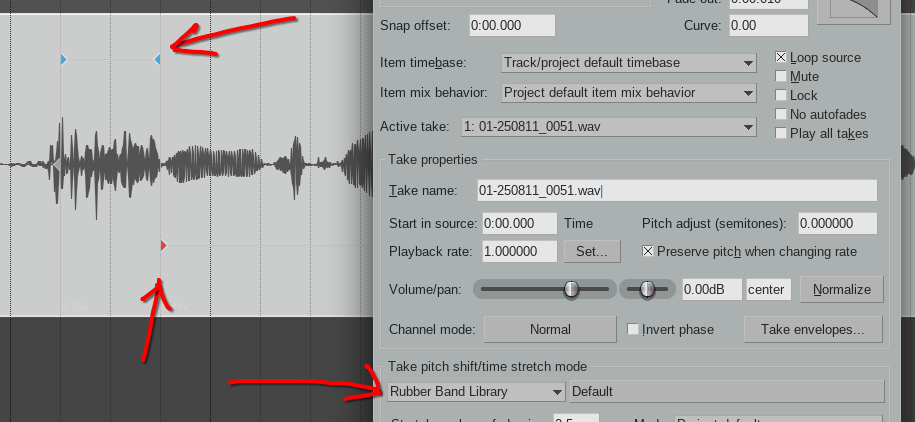
But take look at Reaper, you can set stretch mode to “Rubber band library” in a clip properties and still use the markers directly on the track, not in a separate window:
BTW. Use of markers to bend audio is a way better if you can manipulate them directly on track and not (only) in separate edit window (Bitwig like). This way you can align multiple tracks together which is very important.