My standpoint on where Ardour should develop

“In my experience, most DAWs focus heavily on audio processing. The MIDI side is treated rather poorly, even though it’s essential for audio work as well—especially for automation. But editing MIDI data in Ardour, as in many other DAWs, is not very intuitive in my opinion, especially compared to MusE. Either MIDI editing needs to be significantly improved, or the integration with dedicated MIDI sequencers needs to be better.

On the other hand, these very MIDI editors seem to be dying out. So the question is: how can we edit the control of MIDI signals (notes, controllers, SysEx strings) in a comfortable and intuitive way? And what about connecting external software synths? In Ardour 8.10 that’s still a complicated task—particularly writing and integrating your own sound libraries or sound maps that you can select with a mouse click.

The synth industry also keeps releasing new devices and programs. What if a newly purchased synth doesn’t have a map in Ardour yet? MusE, for example, handles these things much better. But in contrast, its audio capabilities are quite modest.

Using templates isn’t a bad idea either, but if everyone uses the same templates, it comes at the cost of variety. That’s my point of view.
I’d much prefer to see an explicit list of which MIDI editing operations are “not very intuitive” than the handwaving “editing MIDI data in Ardour […] is not very intuitive”. The former, I can take action to improve, the latter I can only ignore.

I don’t really understand what you mean by “writing and integrating your own sound libraries and sound maps that you can select with a mouse click”. This sounds like creating an SF2 or SFZ file that can be loaded into a plugin “at the click of a mouse” … there are tools for this, but it’s rarely, if ever, been part of any DAW …

3 Likes

The piano keyboard with some CC’s knobs or sliders is the one of the best interfaces for MIDI. I do not think MIDI was created with editing in mind. Editing was never intended to be a way of making music. MIDI is a way to record , playback, and send signals.

Editing is a pain in any daw. It is easier to record MIDI as it is intended to be played back. You can delete a bad note, move some mis-timed notes if needed.

Most of the time, re recording or a punch in is easier and much quicker than editing MIDI.

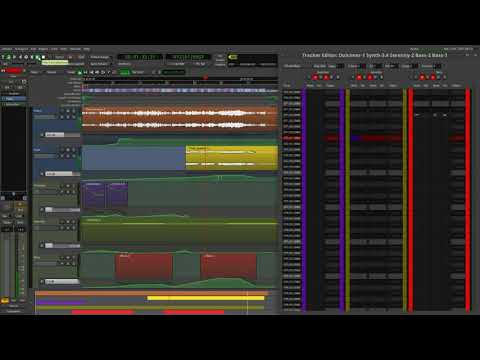
I think you should watch some videos of people using a 90s-style “tracker” interface to create & edit MIDI. The good ones are astonishingly fast, and do things that rival any virtuosic performance on a physical instrument.

Pianoroll editing? Not so much.

1 Like

I think I will. I had an C64 and Amiga 500. The demo songs were fantastic back then, and still are today. OpenMPT is an excellent piece of software. I personally would rather use a piano keyboard or other midi interface.

Any video suggestions ? I was unable to find anything showcasing this on YouTube.

A friend of mine is currently developing a program for creating and editing midnam files via UI. Potentially using a sysex dump from such devices to create a rough outline of it for initial editing but while this has proven to be difficult, it’s not impossible (device dependent).

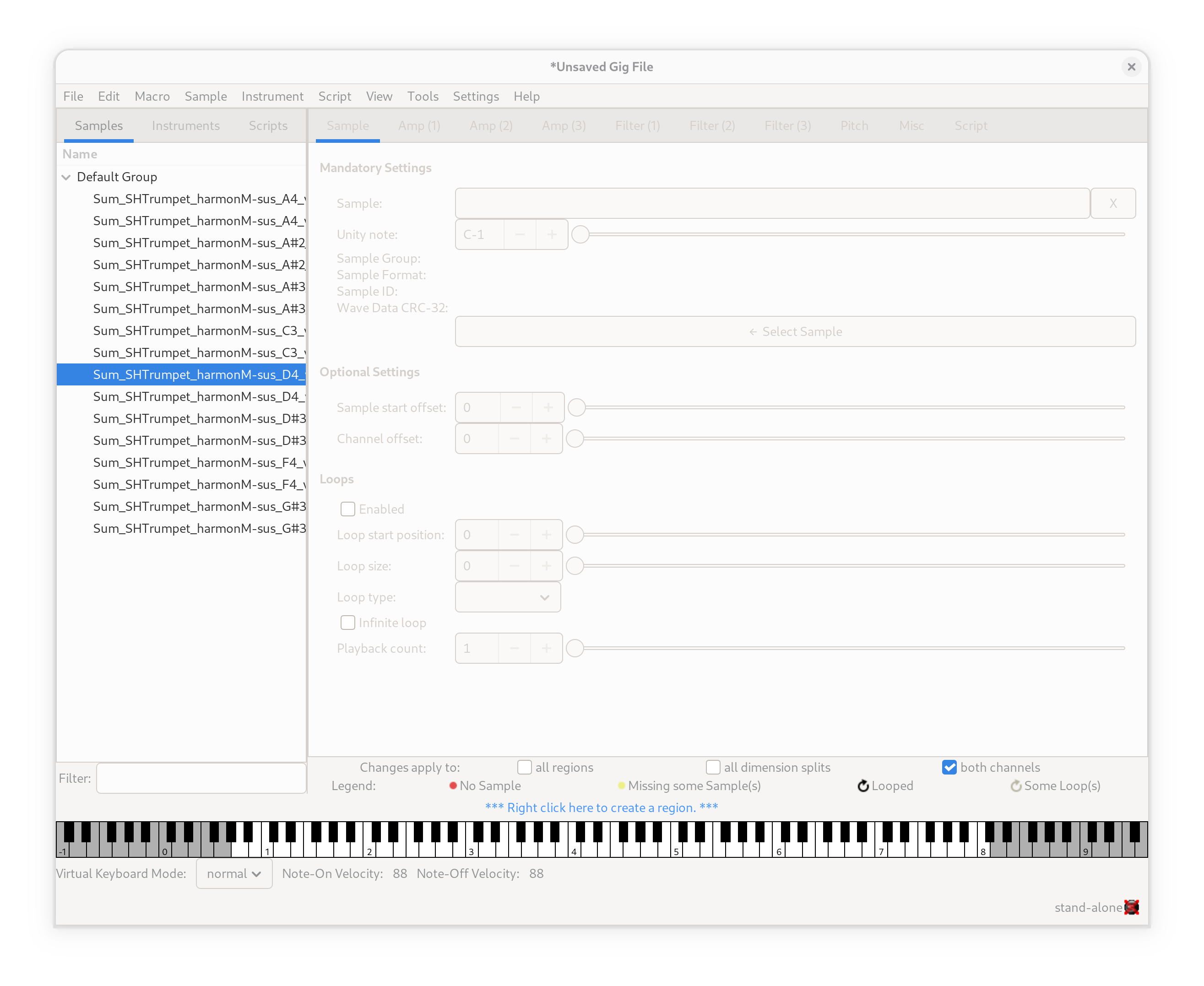
I am presently attempting to write a command line based (for now) Gig2Sfz converter, since neither are currently available for Linux but I think would be very useful. There are lots of fantastic old gig files available but are rarely supported by modern samplers now, with the exception of LinuxSampler which is not very well maintained, which is unfortunate. GigEdit is practically useless and is married to a deprecated gtk2 GUI. SFZ is a much better format in the end, imo.

Both are in early development and it may be a while before betas are released, if they actually can do what they are designed to do. lol

This one’s all fun watch but not the greatest example

This one better demonstrates speed and efficiency

I absolutely love Renoise. Absolutely fucking love it.

1 Like

There was also this initiative:

I find Ardours midi editing very intuitive. Since the op refers to muse, I suppose what he want is score editing. Scoring is not intuitive to many folks.

The only thing I miss in Ardour for midi authoring, is automation regions and something like the note expression editor in Cubase or Bitwig for MPE.

If anyone want to go more loopy/repetitive sequencer style and add some procedural things to their composition, I can highly recommend Stochas or B-Step.
Just insert them before your instrument in any channel and you get a whole lot of features some people miss.
Also, on Linux, just route Bespoke, supercollider or Pure Data, either as midi or audio source into Ardour, if the above should not be enough.
And use musescore if you want a scoring editor with midi output. I do not think it will go away anytime soon. Not sure where OP got that notion. On Linux and macOS, you get this routing for free and even on windows, M$ there is now a new midi system to facilitate this.

In addition to the quite limited sound font format, there is hise for bigger projects, such as deep sampling for expression etc.
Edit: forgot this, if hise or sfz is too much, because all you want is to play a single sample, there is just a sample

The possibilities are endless and ardours open structure makes integrating them possible, like almost no other DAW.

Would be interesting to think about concepts beyond the piano roll. Strudel/tau comes to mind as a recent development, with inline visualizations etc.

What I did not see yet, is a painting like interface to note and event creation. Something completely free, like metasynth back in the days, or capybara.
Edit: forgot about din, it is very fun, if it does not crash. It has a lot of innovative event creation ideas

No, he is referring to the MusE sequencer not MuseScore. And yes, it has quite remarkable MIDI editing capabilities, although Ardour 9 will probably come close. However, I’ll still miss the ‘ghost track’ note editing feature that MusE supports.

1 Like

Good to know, never looked closely at that one. Thanks for the hint. Got confused by the similar naming.
Been looking at the website a little, it is not cross platform. That’s probably why I did not yet have it on my radar.

There is also PlugData (Pure Data as a plugin), and these days you can also use Cardinal as a plugin to get access to the many generative/sequencing possibilities of its modules. If you pay for VCV Rack, you also get the plugin version of that, which has slightly more modules available than Cardinal. Cardinal’s own module to provide sync with the host (Ardour in this case) is excellent.

1 Like

It has been possible to build it with GTK3 since 2017.

1 Like

It’s not just similar. Muse the score editor is a direct descendant of MusE the MIDI sequencer. Werner Schweer removed the score editing code from MusE and created a separate program focused on just score editing.

Years later, MusE developers added a new score editor anyway. And Muse the score editor got a pianoroll editor in v3, then planned it for v4 and never got to merging the patch. Here is the demo:

Funnily enough (or not), there used to be a patch adding a basic score editor to Ardour. Somewhere in a branch of a fork on GitHub. I can’t quite recall what happened to that work.

But then again, there’s a fork of Ardour by @ngeiswei that adds a tracker-like editor. So there’s that, too.

3 Likes

While that may be true, those patches were never merged into the main project. It would be a lot of work, for a (mostly) dead format.

Are you sure?

https://svn.linuxsampler.org/cgi-bin/viewvc.cgi/gigedit/trunk/configure.ac?view=markup#l92

Thanks for promoting the Ardour Tracker Editor development. I am happy to report that progress is happening, in fact I have recently reached another milestone and I feel it starts to make sense to consider making a pull request, although I would prefer to thoroughly test it before that.

And because I am not ashamed to use any occasion to promote my music that nobody otherwise cares, let me mention Staroshiro, my last release made with it.

4 Likes

Pretty sure as I just built the entire LS suite on Fedora 41 last week and gigedit still required gtk2-devel and gtkmm2.4-devel. Also because of this requirement I was unable to build Gigedit for Fedora 42/43.

But from your interesting link, I will do a bit more research on this. Thanks.

I’ve just built the latest gigedit from SVN with GTK3 UI on Fedora 42.

2 Likes

Yes, GTK 3 is the standard for a good time. Are the distros that’re late? Anyway, Old or not, the GIG format is still one of the best IMO, and Gigedit does the job very easily, in particular for drums with the need for multi dimensions if one really wants some real human feel.

2 Likes