Yeah, I was thinking of adding a tooltip or some other popup to the chord selector saying “You know, there are these cheap devices you can get to make entering chords really fast and really flexible. They tend to have a lot of black & white in their design, don’t cost much and have all kinds of uses! You might want to consider that if you’re using this a lot”
2 Likes
All i am saying is they do exist, in a certain genre they used quite a bit, and some people use them in other contexts too. One of those people is me, and instead of having to enter them each time manually, i put them in my clips library. Of course i don’t call them “rootless chords”, i am not a fan of fancy terms, as to me it is just a possible voicing for a given chord (just like inversions are just possible voicings to me, and the earlier mentioned spread/open chords, and all extensions and alterations. Just voicings of pretty basic chords ).
Wether or not it makes sense for the new feature in ardour i can’t answer, and i am not the one to decide such.
(on a side note: all you said is just as true for pretty much all other chords in the original list, besides the most basic chord forms, major and minor, and their inversions. As if there were a heck lot of non-trained people knowing what the heck to do with a diminished chord, a sus-chord, so forth. I gave them, either they gonna get used or not ).
Memento: " a chord isn’t a specific chord until the bass decides what it is" 
3 Likes
You’re right, this looks ridiculous, however I guess that any musician with some degree of experience could “interpret” them all correctly (taking off those that are just wrong as @ccaudle pointed out).
Of course everyone has their own favourite style for chord writing, but that doesn’t mean they can’t understand different ones. Which leads me to the conclusion that if Ardour offers 2/3 name variations for the same chord, it should be enough to make most of users happy.
My 2 cents.
If we assume that all chords have a root, then it does not need to be specified. the ‘0’ at the beginning of all chord definitions can be skipped.
But, looking at the Cubase-video, there can be ways to add a rootless version of the chord to the track, in the same way as adding/modifying a “drop 2” or “drop 3” version of the chord, or an inversion. It would just be another modifier button when adding/modifying chords.
1 Like
This is really getting muddy. @paul I assume the goal is to have something like the Cubase example you gave, and we’re just providing you with a list of possible names and their respective “spellings”? Is it any more than that? All this talk about “rootless chords” (yes, I saw that that name was disavowed  ) makes me want to put my music degree in the shredder. We’re not worried about substitutions, implied harmony, etc etc.
Although, I’m not sure if a composer/producer would find it useful, and not sure if the Cubase stuff already does this (didn’t watch the whole video), but maybe having a check box (or shift key) for “do 2nd inversion” or “drop 3” or whatever might be interesting. Quartal harmony could be a challenge… you want all perfect 4ths, or stick with current “key center”, or what? I think anyone who knows enough about it would be doing keyboard midi input already.
Those is my two cents!
Edit… I should have read @andreas.kagedal post… I’m partially just echoing that. Although you do have to specify the lowest note somehow, and specifying it as zero is ok to me. I realize it’s not necessarily the “root”
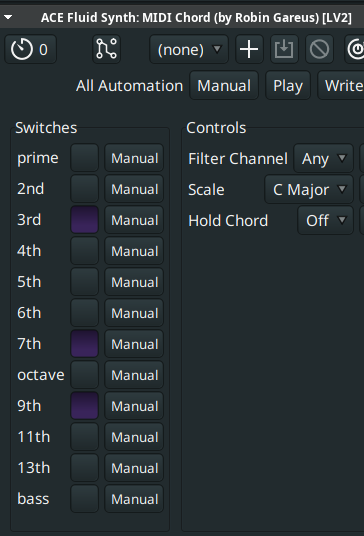
The formerly mentioned plugin “Midi Chord” does this pretty straight forward. You just de-select it. On a chat note (to hype the plugin )
1 Like
There’s already a button for drop 2, drop 3 and drop 3 + 4, as in Cubase, along with inversion up and down.
The idea of collecting chords and names is to help later when the user will be able to pick which chords show up in the GUI for “easy access” (rather than just sticking with the list derived from cubase). We’ll refer to them by (one of) their names (maybe >1 ?) and then use the definition.
1 Like
I like your 3rd, 7th and 9 example. Typical in Jazz.
The 5th is redundant, and the root note is usually too. What identifies a chord is indeed the 3rd and 7th, and add the 9th as flavor, or go up to 13th (6th an octave up complements the 3rd).
Then again the goal here is not be to write changes. I expect users with that knowledge will be a lot faster with a MIDI keyboard.
I think the goal should be to make the common case fast and not handle complex cases.
just my 2c.
2 Likes
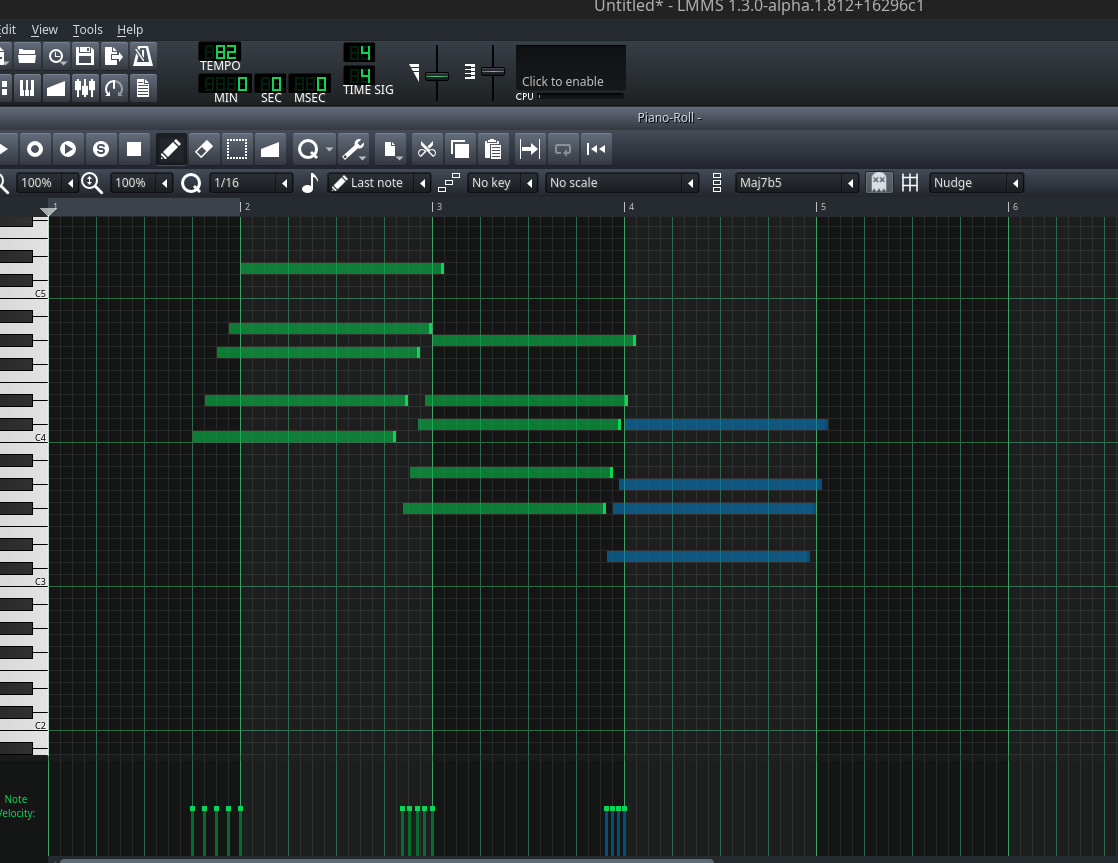
Maybe, when everything is working fine with the chords, it is possible to add a guitar strum feature to the chords. This means you grab a chord and pull all the notes in the chord before the beat, so that the highest note of the chord lands on the beat. That’s how guitar players do it.
I know that LMMS is not maintained much these day’s but i got this feature to be implemented in an Alpha version 1.3.0 appImage on linux, see picture.
The next request will be from someone saying “but I generally in the opposite direction than normal, so I’d like the lowest note on the beat”. It’s like the “Joni chords” …
It was just a thought…i know Robin made a midi strum plugin.
Looking at the actual implementation in nightly builds, to me it looks as if a heck lot would be already covered the way it is right now, for a guy like me there is nothing missing ( I am pretty amazed, which i didn’t expect).
What i don’t see in “4-note chords” is a major6, and though i for one don’t use it, i think it is a very common chord for most or a lot of people.
Just in case it was overseen, if this is a decision, that was not my point.
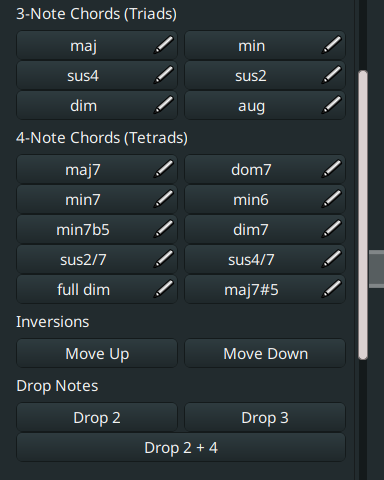
+1 for major 6 (actually just “6”).
I still cringe at “dom7” and “full dim”.
There are diminished and half-diminished chords. I never even heard about “full diminished”.
You can have a 7th chord that is not the dominant. Dominant is the fifth scale degree. It is an orthogonal concept. You can also have a dominant minor chord for example (which may or may not have a 7th).
3 Likes
Agree.
Also, what is the difference between “dim7” and “full diminished”? One of the buttons could be used for “6”.
(Also also, in most countries (using European pitch names) that “dom7” means “C minor 7” )
Yes “dim7” and “full dim” should be the same thing. Here is the wikipedia page:
Diminished seventh chord - Wikipedia which mentions:
the name ‘diminished seventh’ conventionally refers only to the ‘fully diminished’ version of the chord
I agreee that the “6” chord should be included.
For reference, here is the list of chord symbols supported by the app IReal Pro which is very popular with Jazz musicians.:
I don’t think Ardour need to support all of these, but perhaps it should be possible to have a few buttons where you can add your own chord definitions?
Another thing. How is the “Inversions - Move Up/Down” work in relations to the drop 2 and drop 3 buttons? Just moving the lowest note one octave up/down does not work when the chord span is greater than one octave. That is if you select a chord then, then apply the drop 2, then do a move up and then a move down will you end up with the same chord you had before you did the up-down thing?
1 Like
from the linked page (iReal Pro)
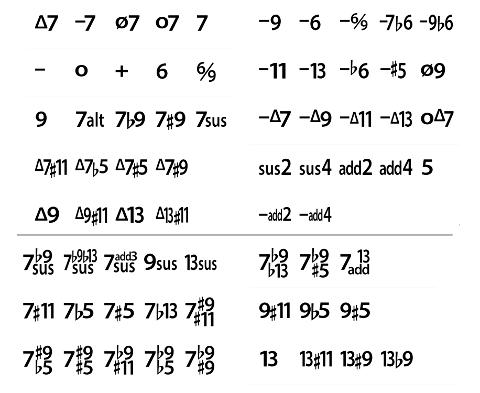
It’d be lovely if Ardour would also show this notation.
2 Likes
Alllriiigty, an chord assistant. Cool.
(To be honest i hated it when it first turned up in Cubase…felt a little betrayed. Guess i simply miss the days when knowledge used to count for something).
Aldo i don’t like the idea of tone deaf people being able to create anything even remotely okayish sounding, it’s a nice feature to have so you don’t have to draw every single note from scratch.
Well…programmed drums are here for decades (and i do use 'em even for rock), freaking AI is here(and i also use it, not exactly gladly or willingly) , so, why not also a simple chord assistant?
As you can all see, i can’t realy decide on which side of the argument i stand (as if there is an argument in the first place )
On the bright side - there are some chords listed here of which i never heard of in my entire life…so i guess you can also learn something using this tool?
I’ll use this feature to learn the names of chords I’ve already been playing for 40 years…lol. Having played in D-standard and Baritone tunings most of the time I rarely know what actual chord I’m playing, I just know when it’s the right one…
4 Likes
Heheh, reminded me of my friend, a guitar player…
About 15 years ago, we got bored of only playing our songs, so we regrouped as a side thing, and formed a Pearl Jam tribute band.
I got the role of singing and mostly playing rythm guitar, so i tuned my guitar to D#standard, so i could sing Eddie’s parts.
He had to keep his guitar in E standard couse of floyd rose.
We could’ve definitely make use of this chord assistant as a conversational tool back then
- “It’s C”
- “No it’s B”
- “I meant the real C”
- “Real C? As in - real C for me?”
1 Like