Help Ardour by naming & adding chords

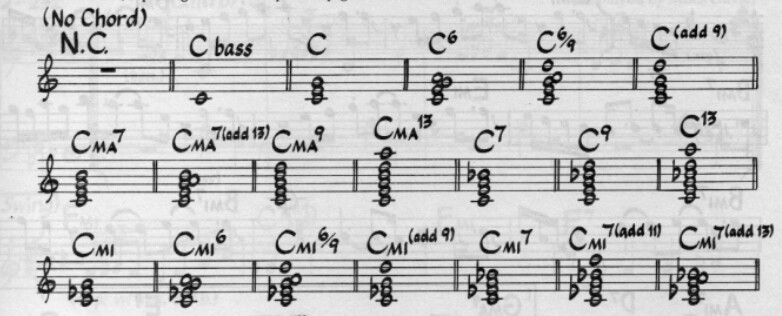
The upcoming 9.3 release will feature some new functionality for chord editing. As a part of that, Ardour now contains some chord definitions. Chord naming is a famously problematic area of musical practice, with many different approaches and conventions. So, below is a list of the chords that we currently defined, presented like this:

{… list of intervals (using western-centric terms … } (“name1”), (“name 2”) …

(any chord can have an unlimited number of names. The first one is consided the canonical name and should be written out “in full”.

I’d like to invite Ardour users to do one or both of two things:

  1. Add new chord definitions to this list. Put them in your comment in a similar format as the list below.

  2. Add additional names for the chord definitions already present

Notes: the intervals use the following definitions:

	P0 = Unison = 0
	m2 = MinorSecond = 1
	M2 = MajorSecond = 2
	m3 = MinorThird = 3
	M3 = MajorThird = 4
	P4 = PerfectFourth = 5
	A4 = Tritone = 6
	d5 = Tritone = 6
	P5 = PerfectFifth = 7
	m6 = MinorSixth = 8
	M6 = MajorSixth = 9
	m7 = MinorSeventh = 10
	M7 = MajorSeventh = 11
	P8 = PerfectOctave = 12
	M9 = MajorNinth = 14
	P11 = PerfectEvelenth = 17
	M13 = MajorThirteenth = 21

For some intervals beyond the octave, the list uses just a semitone interval from root. New chord definitions can use any of the 3 forms (short, long, semitone count from root) shown above.

Also, if you see errors in the list below, I’d happily take corrections for them too!

{P0, P5},                                   ("Power (5th)"), ("pow5")

/* triads */

{P0, M3, P5},                       ("Major"), ("maj"), ("major")
{P0, m3, P5},                       ("Minor"), ("min"), ("minor")
{P0, m3, 6},                                  ("Diminished"), ("dim")
{P0, M3, m6},                         ("Augmented"), ("aug")
{P0, P4, P5},                    ("Sus4"), ("sus4")
{P0, M2, P5},                      ("Sus2"), ("sus2")

/* tetrads */

{P0, M3, P5, 11},         ("Major 7th"), ("maj7")
{P0, M3, P5, 10},         ("Dominant 7th"), ("dom7")
{P0, m3, P5, 10},         ("Minor 7th"), ("min7")
{P0, m3, 6, 10},      ("Half Diminished 7th"), ("halfdim7")
{P0, m3, 6, 9}, ("Diminished 7th"), ("dim7")
{P0, m3, P5, 11},         ("Minor/Major 7th"), ("min/maj7")
{P0, m3, 8, 11},       ("Major 7th/flat 5"), ("maj7b5")
{P0, m3, 8, 11},       ("Major 7th/sharp 5"), ("maj7#5")
{P0, m3, 6, 10},      ("Half-Diminished 7th"), ("m7b5")
{P0, m3, 6, 8},        ("Diminished 7th"), ("dim7")
{P0, M3, m6, 10},           ("Augmented 7th"), ("aug7")
{P0, M3, m6, 11},           ("Augmented Major 7th"), ("aug-dom-7")

{P0, M3, P5, 14},                   ("Add9"), ("add9")
{P0, m3, P5, 14},                   ("Minor Add9"), ("min/9")
{P0, M3, P5, 8},                   ("Major 6th"), ("maj6")
{P0, m3, P5, 8},                   ("Minor 6th"), ("min6")

{P0, M2, P5, 11},                ("Sus2/7"), ("sus2/7")
{P0, P4, P5, 11},              ("Sus4/7"), ("sus4/7")

/* Pentachords */

{P0, M3, P5, 10, 14},     ("Dominant 9th"), ("dom9")
{P0, M3, P5, 11, 14},     ("Major 9th"), ("9"), ("maj9")
{P0, m3, P5, 10, 14},     ("Minor 9th"), ("min9")
{P0, M3, P5, 8, 14},       ("Major 6/9"), ("maj6/9")

/* Hexachords */

{P0, M3, P5, 10, 14, P11}, ("Dominant 11th"), ("dom11")
{P0, M3, P5, 11, 14, M13}, ("Major 13th"), ("maj13")
8 Likes

Why is that not written as {P0, M3, P5, M7}? That seems more consistent than switching from interval names to ‘11’.

I guess the short form should be "aug-maj7"

The half diminished is repeated. Maybe add the name ("m7b5") as third alias?

On a more general note, I have never seen “dom” for “dominant”. I thought the general rule was: just the number (C7, C9, C11 …) means with dominant 7th (10 semitones), if it is major 7th (11 semitones) then it says “maj” (Cmaj7, Cmaj9, Cmaj11 …).

No particular reason. Just what I had :slight_smile:

I think it’d be easier to read if it was all just chromatic intervals instead of mixing things.

Please write 7, instead of P5, particularly since it will be 7 semitones and not a perfect fifth (3:2) to begin with*.

Also all rock guitarist will want a dominant 7, sharp 9 chord as part of the set, and all jazz guitarists a dominant 7, flat 9.

(*) the definition of “perfect” here differs depending on historical influences in a given part of the world.

Add the definition and at least name for each, please

{1,4,7,10,15} “Hendrix chord 7#9”
{1,4,7,10,14} “7b9”

Italian and French 6th chords

I guess we’d be talkin’:
{P0, M3, m7}, (“Italian6th”), (“ital6”)
{P0, M3, A4, m7}, (“French6th”), (“french6”)

Tristan chord is just an inverted m6.

The short form is just 7 here (not “dom7”):

1 Like

I guess if we’re going to get all jazzy, throw some poly chords in there. For an easy example, on the keyboard, left hand doing a major F triad, right hand doing a major G triad, would be notated ⁠G/F … not to get confused with slash chords specifying the root.

I want chord definitions and names, not discussions :slight_smile:

1 Like

If in doubt, ignore. Just to me both are a quite common things i use. I hesitated if i should make the proposal at all, for quite a while.

I am not sure if “rootless chords” is even possible,
something like:
{m3, P5, M7, 14} ( “rootless minor 9”)

i am not sure if “spread chords” or “open chords” are wanted (perhaps not possible too, cause the needed intervalls are not all in the given intervalls list ).
something like
{P0, P5, M10, P16} (“spread Major”), (“open Major”)

fairly sure that the rootless chord needs to be defined with the first note as unison/P0/0 the rest of the intervals computed from there. So: { 0, 4, 8, 11 } or “musically” { P0, M4, m6, M7 } which I believe is an augmented major 7th.

All intervals are available for spread chords, by just using semitone counts from the root.

You’ll also find:

{P0, M3, 10}, (“Dominant 7 no 5”), (“dom7no5”)

1 Like

Still not too sure i got the concept correct, but i did my best to create open or spread voicings for the chords:

/* spread/open triads */

{0, 7, 16}, (“Major”), (“maj”), (“major”)
{0, 7, 15}, (“Minor”), (“min”), (“minor”)
{0, 6, 15}, (“Diminished”), (“dim”)
{0, 8, 16}, (“Augmented”), (“aug”)
{0, 7, 17}, (“Sus4”), (“sus4”)
{0, 7, 14}, (“Sus2”), (“sus2”)

/* spread/open tetrads */

{0, 7, 16, 22}, (“Major 7th”), (“maj7”)
{0, 7, 16, 21}, (“Dominant 7th”), (“dom7”)
{0, 7, 15, 21}, (“Minor 7th”), (“min7”)
{0, 6, 10, 15}, (“Half Diminished 7th”), (“halfdim7”)
{0, 6, 9, 15}, (“Diminished 7th”), (“dim7”)
{0, 7, 11, 15}, (“Minor/Major 7th”), (“min/maj7”)
{0, 6, 11, 16}, (“Major 7th/flat 5”), (“maj7b5”)
{0, 8, 11, 16}, (“Major 7th/sharp 5”), (“maj7#5”)
{0, 6, 10, 15}, (“Half-Diminished 7th”), (“m7b5”)
{0, 6, 9, 15}, (“Diminished 7th”), (“dim7”)
{0, 8, 10, 16}, (“Augmented 7th”), (“aug7”)
{0, 11, 16, 10}, (“Augmented Major 7th”), (“aug-dom-7”)

{0, 7, 16, 26}, (“Add9”), (“add9”)
{0, 7, 15, 26}, (“Minor Add9”), (“min/9”)
{0, 7, 16, 20}, (“Major 6th”), (“maj6”)
{0, 7, 15, 20}, (“Minor 6th”), (“min6”)

{0, 7, 14, 23}, (“Sus2/7”), (“sus2/7”)
{0, 7, 17, 23}, (“Sus4/7”), (“sus4/7”)

/* spread/open Pentachords */

{0, 10, 14, 19, 28}, (“Dominant 9th”), (“dom9”)
{0, 11, 16, 19 , 26}, (“Major 9th”), (“9”), (“maj9”)
{0, 10, 15, 19, 26}, (“Minor 9th”), (“min9”)
{0, 7, 16, 21, 26}, (“Major 6/9”), (“maj6/9”)

/* spread/open Hexachords */

{0, 10, 16, 19, 26, 19}, (“Dominant 11th”), (“dom11”)
{0, 11, 16, 21, 26, 31}, (“Major 13th”), (“maj13”)

For the triads i’d sure add another root note with higher pitch, as else it is a bit too thin, but then they not really triads anymore, i guess. So i left it as is.

2 Likes

I think:

  • the first chord the third note, the flat five, is a 6, not a 8.
  • the first and the second chords are either a Minor chord in the name , or the m3 is meant to be a M3
  • The fourth chord, fully diminished, the fourth note is a 9, not an 8 (otoh then, if it is a fully diminished, it is not a 7th chord anymore. The “8” looks like a minor 6 this way or the other to me)

As said: I think. Someone might have a look.

You are correct. Should be:

{P0, M3, 6, 11}, (“Major 7th/flat 5”), (“maj7b5”)
{P0, M3, 8, 11}, (“Major 7th/sharp 5”), (“maj7#5”)
{P0, m3, 6, 10}, (“Half-Diminished 7th”), (“m7b5”)
{P0, m3, 6, 9}, (“Diminished 7th”), (“dim7”)

1 Like

Another, i’d claim rather famous, Pentachord
{0, 5, 10, 15, 19}, (“So What chord”), (“Minor 11th”), (“stacked 4th”)

How will this chord lexicon be used in upcoming Ardour versions? Would help me understand whether inversions, voicing, etc are useful to enumerate.

1 Like