Yes, without details of the new feature, this seems it could indeed be a very complicated endeavourer. Not sure where this is going.
The crux of this design is:
- chords are canonically identified as a series of intervals from the root
- there can be an arbitrary number of names for any chord
- we do not parse chord names to determine the intervals in the chord
Right now, enumerating chords is only useful as a way of identifying the chord represented by a set of identically timed notes.
In the future (not that distant of a future, either) you’ll be able to
a. choose which chords appear in the pre-existing lists for MIDI chord editing
b. define any additional chords that you want, and name them
Ardour will not care if you call a chord “winky woggly woo”, or “Cmaj” even if the root isn’t C and it isn’t a triad and doesn’t use the 4 and 7 semitone intervals.
1 Like
Are the chords hard-coded into the source, or is there going to be an editable text file ?
See point b. above …
For now, they are hard-coded.
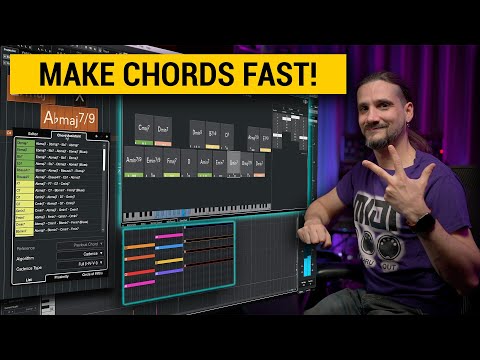
Watch the first part of this video about Cubase to see where this is pretty much at already …
2 Likes
That is pretty damn impressive actually. It would seem once you have the root chords defined you can adjust to any deviation of that chord fairly easily. This would most certainly be a welcomed and powerful addition.
While i sure see how the concept or solution in cubase is different and also might have more power or comfort , creating chords at least fast works well for me already by using either
- the plugin midi-chord (written by Robin Gareus, but i don’t see it at x42-plugins website, perhaps comes with ardour) or
- by dragging chords (or chord-progressions, if that is what i want) from the Ardour Bundle in editor-list (well, or make your own “templates” in the clips library).
Yes, quite an exciting new feature ahead, i just say the available solutions are not that bad either (i omit the drawbacks both might have compared with the seen solution, i see them, sure).
Just saying, it took me a while to find those already existing and pretty cool solutions, perhaps not everyone is aware (just like i was not aware).
Long story short: very exciting news here.
Clearly, by “winky woggly woo” you really mean "“woggly woo winky, 2nd inversion.”
Exciting stuff here - as always, thanks!
1 Like
It is absolutely not the 2nd inversion! Its “woggly wobbly woo”, but played without Wobbly and over a winky, but the winky is two octaves down, not 1. Jeez, musicians …
5 Likes
I think: The 4th note, “intervall 8” is a flat 6, not a 6 (which if i am not wrong is the intevall 9 then):
{P0, M3, P5, 9, 14}, (“Major 6/9”), (“maj6/9”)
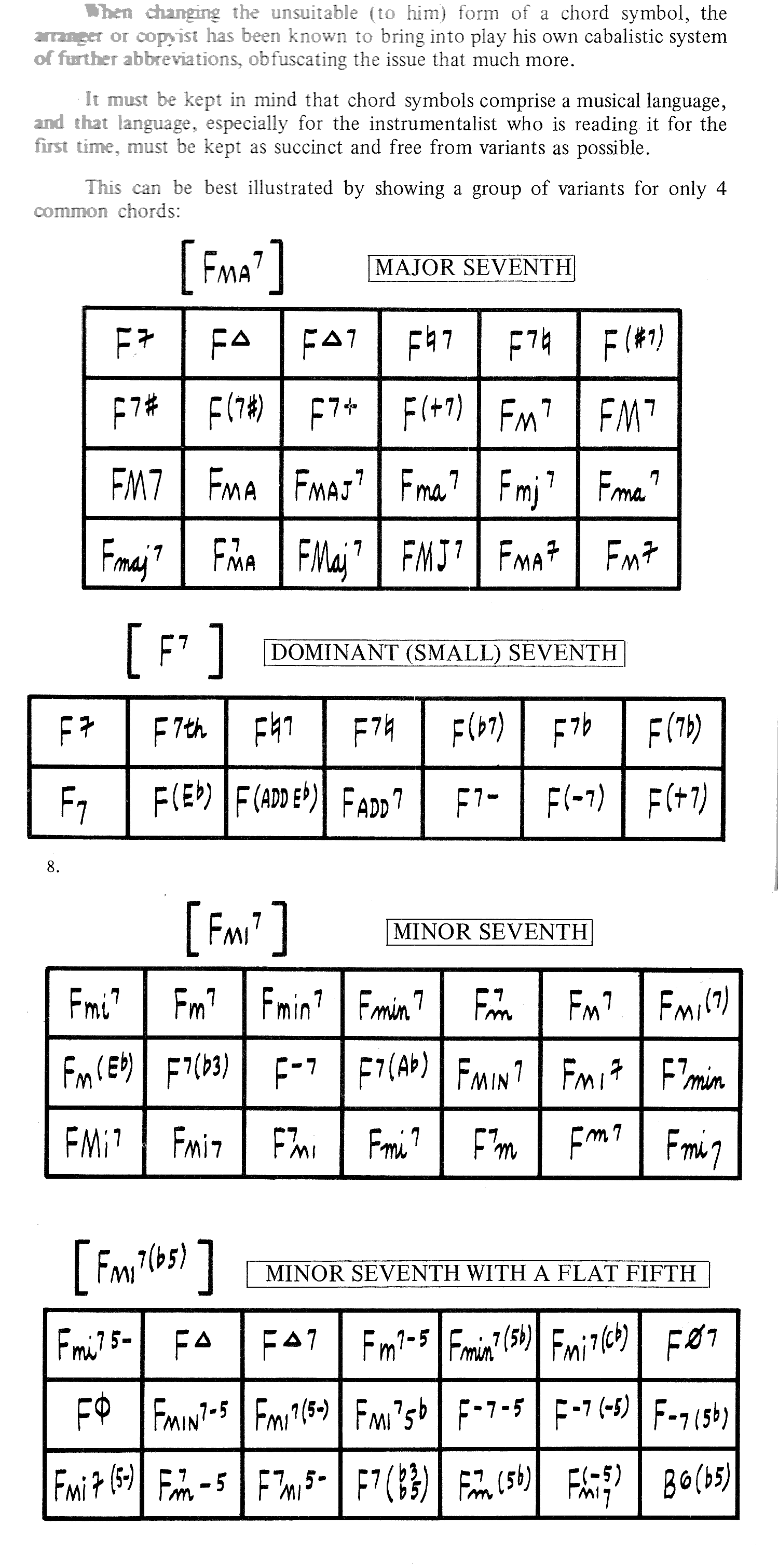
For those who perhaps are not aware of the ridiculous diversity of chord naming conventions, here is an excerpt from “Standardized Chord Symbol Notation” by Carl Brandt & Clinton Roemer (1976)
1 Like
Some of those are just wrong.
I also like how there are some identical names in the charts for different chords.
And don’t even get me started about how some people  insist on calling quarter notes “crotchets.”
That’s what you say 
1 Like
I would start a fight with someone who tried to tell me that 𝄰7 means play the natural 7, and 𝄮7 means play flat 7th.
1 Like
Trying to get back on topic.
What i didn’t understand if you think adding a couple of rootless chords to the list would make sense or not.
It sure is an edge case, though not unusual in for example Jazz, and i am not even sure if for the given problem in ardour it even makes that much sense. Also i for one could only come up with i think 3 (good old 2-5-1 chord progression, for minor 2-5-1 i’d already be clueless. ).
Well, less talk, here they would be:
/* rootless tetrads */
{0, 3, ,7, 10, 14 }, (“rootless Min7 Add9”)
{0, 10, 14, 16, 21}, (“rootless Dominant 9/13”), (“rootless Domintan 6/9”), (“rootless Dominant 13”)
{0, 4, 9, 11, 14}, (“rootless Major 6/9”), (“rootless Major 13”)
0 is omited for all of them. No clue how to write that, or if it is even possible in the given usecase.
a “rootless” chord from my POV is just a different chord. If its a tetrad consisting of (arbitrarily, randomly chosen) {0,3,7,9} and you play it without the root, then its a triad consisting of {0,4,6}.
I know that musicians wouldn’t name it that way at all, but the result is the same. So “rootless” versions of various chords with the root removed and intervals adjusted to match would be a good idea.
1 Like
Yup, hence my doubts. The first chord above, assuming we in C-major key, a rootless D minor 7 with a 9, is just a F-major7 chord. Same for the others, i assume, but not as obvious as for the first, to someone like me. If others are willing to offer it, nice, i for one said all i am able to say regarding rootless.
The first chord above is { 0, 3, 7, 10, 14 }. The rootless version is { 0, 4, 7, 11 }. Whatever else that chord might be called (e.g. Major 7th), it can also be named “Rootless Min7 Add9”.
I know that in musical practice it is normal to use the root in the name to differentiate chords. But the reality is that a C Major 7th and a D Major 7th and a rootless F Minor 7th Add9" all have the same intervals. They may function differently if you’re into harmonic analysis, but in terms of chord definitions, they are the same thing. So when you’re creating a chord, given a root note (as happens when drawing chords in Ardour), it doesn’t matter what name you want to use - they are all the same set of intervals and the drawn chord will the same whichever one you choose.
I really wish that western music education focused more on intervals and less on pitches.
Couple of comments:
So-called “rootless” chords are often an artifact of arrangement, meaning that they are only “rootless” if you look at one particular instrument, but often a different instrument actually is playing the root of the chord.
And by time you get to that level of controlling the arrangement, is this even applicable? This seems like something to help people who want to make some music but don’t actually have any musical training.
The thing that struck me when looking at the cubase video is that it saves no time over just having a small MIDI controller sitting on the desk, and you also lose control over inversions and voice leading which will make all the arrangements sound like they were made by a grade school music student.
Yes, great if you want to crank out some quick techno without spending a few hours learning how to finger chords on a piano layout, but is that really the target market for pre-made chords that are “not unusual in for example Jazz?”
Although to be fair EDM could use some more harmonic sophistication, so I’m not going to say anything more if you want to put in the effort for this. Maybe someone will learn to make some jazzy techno with it.
3 Likes