Thanks a lot you all!
I’m very happy with this new version, lots improvements. Most of all the seperate Midi-editing window (aka pianoroll).
Two things to further improve I think:
The sidebar on the pianoroll-window takes up a lot of space (show/unshow or resize options?).
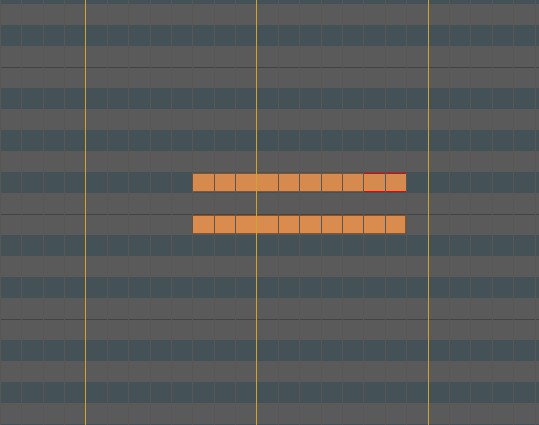
The gridlines in the pianoroll are in front of the notes, not behind. It’s almost impossible to see the difference between one long note and a lot of short notes (see picture).
The lowest one is the long note. The other is five notes.
I still hate it and think it is stupid
I have all those feels for FLOSS software I maintain.
People insist on using our software in ways that make no sense to those of us who maintain that software: OY GEVALT FUER ME!
I’m particularly puzzled about this case, as the only case that makes sense to me for the separate piano-roll window is to allow editing notes across multiple source channels (e.g., arranging all the strings in a given section), which is explicitly out-of scope.
No, that’s not it at all. It’s “people go on and on about a workflow that they think they want, without understanding or learning the workflow(s) that are already possible”.
The main case I can see for the pianoroll approach is actually when dealing with overlapping MIDI regions. And as I’ve said in various places, the main reason for implementing was for editing cues/clips on the cue page - it just happens that doing so makes it possible to use the same stuff for pianorolls anywhere …
Well now, I appreciate what you guys are doing and that you have your view on how to use Ardour and accordingly the workflow that’s most fitted.
I’ve used Ardour for many, many years and I’ve adapted to the possible workflows.
But I still don’t grab why the inline midi-editing with a lack of overview or interaction with all miditracks is a workflow I should understand. For me there are use-cases where Ardour is not the most optimal tool. And that’s ok, I can happily live with that.
It’s a bit disappointing though to read that I apparantly only think that I want a certain workflow.
The plus-points on the pianoroll at this moment:
Using two monitors, I can put the new midi-editing window on a different monitor (that improves my workflow).
In the pianoroll I can select channels and thus have the possibility to use different instruments in one track.
Velocity etc. now easy editable.
The pianoroll is range-centered (giving the fact that it’s primaraly intended for cue/clip-editing). It would fit the workflow, I think I want, more if it was trackbased so I could easily edit multiple layered tracks or jump from one to the other with one click, inline-editing can’t do that.
Sorry, I don’t want to complain, I really enjoy Ardour for 98% and appreciate the work you’re doing.
The ability to do ad-hoc MIDI editing without changing the current editor layout (track heights, timeline position/zoom) – much less distraction for me. Used Save/Go to Views to recall the previous layout, but that was only a workaround
Apparently years with Cubase, Cakewalk and MusE did the irreversible damage, but when 9.0 came, switched to pianoroll editing with a great relief.
I’m also not complaining, especialy not now, when pianoroll is already in Ardour .
Someone said something like “you all bring your wants based on the workflows you use in other DAWs”. There’s some truth in that. I used Cubase for years, still do (mainly because i’m in a kind of forced position to do so - commercial work demands speed, and i rarerly have to think where’s what while using it, and there’s practicaly no Linux users around me). But also, before that, i used FL(all the way back when it was just called Fruity Loops, without “studio”) . FL had that pattern-based workflow that i find lacking in Cubase. But one just couldn’t complain about it to Cubase developers or users, well, mainly because Cubase was light-years ahead in everything else, so it would just sound as a childish demand to other users. You would, most probably, just be mocked for saying that. Recently i saw Cubase devs added pattern-based functionality to the newest version.
Now, if you realy let people tell you what they like (like floss projects often do), they WILL tell you.
That’s why i did, anyway.
I like having pianoroll. I like having channel RTA’s.
(and i would also like having handy manual time&pitch correction ) .
Didn’t mean to be a drag. Everything’s fine. Just sayin’.
I don’t know about the workflows. That’s just secondary. Basically a DAW is a toolbox containing the tools you use to produce your musical endproduct.
You could argue about the quality of the tools or if the functionality of some tool is really tailored to do a certain job. Or if the tools support your creative ideas.
In the end the perfect DAW for everyone is impossible due to lack of money, time and other resources, especially in the foss-world. The developers have to make decisions with priorities in mind. That’s fine.
Like songa, i’m irreversibly damaged (or spoiled) growing up with Cakewalk and Sonar which had a superb pianoroll which contained everything I needed to do the job (like easy working on multitrack polyphonic instrumentparts).
The pianoroll in Ardour is helpfull, I’m confident that it’s one of those tools of Ardour which is going to develop in time.
I would argue this strongly. Workflow is what sets most DAWs apart these days, many have similar toolsets, but the workflow is what determines how easy it is to use certain tools in certain manners. This is why, for many people, Logic is a goto for composition (Or Cubase for instance), but for loop based composition, you have tools like Live, Bitwig, or FL Studio, etc.
Workflow support in the DAW are the choices in how it presents these tools to you, and how you are expected to interact with the daw. If it is more focused on one aspect, those tools will be more prominent and your UX will be focused more around the use of those tools vs others.
As a result workflow support becomes a primary focus for many DAWs and guide many decisions about it.
Ok, I can follow your argument. Maybe, in hindsight, that’s why I really liked Cakewalk/Sonar. Except these were (are) Windows-only applications. Native-Linux means limitation in choice.
The interesting question :
where can we place Ardour on the workflow-scale?
(general purpose?)
Could you correct the grammar in your announcement. I know these aren’t complete thoughts but you should be able to read them out loud without trouble.
Mixer Strips Importing and Exporting
should be
You can now import mixer strips from arbitrary Ardour sessions as new tracks or map existing tracks to processing in mixer strips of external sessions. You can also export strips as local (session-level) or global presets for reuse.
What else i can say other than a huge congratulations to this incredible project, its developers and community.
I have been using Ardour since 2.8.13 ish if i am not mistaken and switched from Reaper since. Long journey with several bumps on the road but you kept going that’s what matters.


 .
. (or spoiled) growing up with Cakewalk and Sonar which had a superb pianoroll which contained everything I needed to do the job (like easy working on multitrack polyphonic instrumentparts).