Would using these two plugins be a viable way to emulate Mixbus in Ardour? CPU and DSP use would be the main factor I’d guess. Has anyone actually tried this? Sure, they are not cheap for the pair, but if they work well with 8-16 tracks, it could be worth the investment.
You could build a channel strip preset with any number of plugins of your choosing.
You cannot emulate the workflow in Mixbus by using conventional plugins, however.
The main benefit of Mixbus is having everything right there in the mixer window without the need of opening plugin GUIs.
(Also recent Mixbus 11.1 includes SSL compressor and EQ.)
@paul and @x42 Thank you both for your replies.
I already own a license for an older Mixbus (v7.2) and do use it quite a bit but I also use Ardour as well (mostly for live recordings), including track templates for both. I rarely use any additional plugins with MB with a few exceptions.
I was self debating whether to upgrade to MB11 or just move 100% to Ardour and use the MB channel/bus plugins as I like the all-in-one features on the channel strips and the tape saturation the busses offer. As I have not worked in professional audio in nearly 6 years now, as a musician I do still record my own tracks, both MIDI and audio with some other musicians I have been playing with on and off for ~30 years now.
Point is, there are many people concerned with SSL now being at the helm, Mixbus 11 may be the last to support Linux, especially if they incorporate the iLok protection mechanism in later releases. My thought would be that purchasing these plugins instead of the full MB upgrade would get me close enough without fear of eventually getting locked out of MB. They have already done this with newer plugins only being compatible with iLok as I recently discovered while attempting to purchase the new Harrison DeNoiser.
Maybe I am just being too paranoid.
1 Like
Airwindows has some Tape emulators and other analog console emulations that may fit your needs.
ToTape8 is a nice tape emulation. ConsoleX may be of intrest, or any of the console series.
These have a basic GUI, but sound good.
I would recommend Airwindows Consolidated plugin to start. It has all the plugins built in and a menu to select. Also there are descriptions in the GUI.
They are free, but you can also support financially if you would like.
Please don’t buy into that FUD. Also it’s audiotonix (not SSL) who’s at the helm and they pretty much leave Harrison on their own, except for shared infrastructure (some of which is provided by SSL, others with A&H).
Given that currently the main Mixbus developers are Paul and me, and we both work on Linux and hate DRM, that is not likely going to happen.
It it also unclear if iLok can be used with GPL’ed MIxbus to begin with.
–
PS. The AVA plugins are entirely separate. The target audience there are users who don’t want or cannot to jump DAWs and need AAX plugins (and most also want iLok  ).
).
5 Likes
Thanks Robin for that info. Very reassuring to know.
I thought Mixbus was proprietary, and Ardour was its GPL’d cousin or something. I guess I was wrong with that thought.
Edit: I was wrong to the silliest levels. Mixbus is built on top of Ardour, which Ardour was always GPL’d. My mistake.
1 Like
Mixbus is an Ardour derivative, the proprietary part is the channelstrip *plugin, which is similar to the one that @Lexridge mentioned above.
If you own Mixbus the GPL grants you the right to get the Mixbus source-code, which is basically just Ardour with a couple of patches for the Mixer GUI and related customization. So if you wanted, you can compile Mixbus yourself, and patch it. Some have done that and contributed MIxbus specific control surfaces for example.
Around 15 years ago Harrison saw the light that one can build a successful product based on free/libre software, which started a healthy collaboration. Ardour gains from Harrison’s decade long insights, and Mixbus benefits from free software contributions.
Most of Mixbus development actually happens in Ardour first.
1 Like
Well there’s the liberals for ya! lmao! It’s so hard to believe that iLok is even still in existence today. Software piracy is nothing like it once was a decade or two ago.
While this may be true, where does one obtain that source code? It is certainly not part of the GIT clone mechanism for ardour.
Free/Libre softeware is always best. I noticed this back whenever Harrison first released the X-Dubber. What a great system. I’ve only seen one in person, but it was praised upon by the owners. Sure, it’s dated by now, but the roots are still here to build on if someone wanted to do that.
The argument there is convenience, particularly if one is already locked into that ecosystem.
The GPL grants users of the software access to the source, so I suggest you email harrison support, and they will provide you with a tar ball, or read-only git.
1 Like
You are exactly right. People hate changes, no matter if for the good.
I will do that. Thank you very much Robin.
PS. I did upgrade to MB11 earlier today. I didn’t need the SSL addons or the Dolby Atmos so I went with the basic version. Thanks for all your input. As a programmer I would be really interested in doing some lua scripts, but I need to learn LUA first. I am the author and maintainer of FreeFactoryQT which is an advanced frontend for FFmpeg. Please check it out on github if you have a need.
1 Like
I’m not in any way an authority on this but I’ve danced with this topic a bit recently and ended up settling on just Ardour with select plugins to sort of emulate the console workflow and sound.
Previously I tracked in Ardour then, after all recording was done, opened thr project in Mixbus 10 and mixed there. Mixbus is incredible for all the reasons already mentioned here and as someone who learnt in traditional console-based studios, I love it.
But my machine is a bit too weak to handle big Mixbus projects plus I didn’t like their changes to the licensing system for v11 so didn’t upgrade and instead tried staying in Ardour for mixing and rendering. And, so far, I’m happier with this approach.
I mimic Mixbus’ topology (channels → busses → mixbus) and have been using ACMT plugins as channel strips for the bulk of mixing changes and although the parameters are not ever-present on the mixer screen, opening plugins to make changes (alt + double-click because screw GUIs) hasn’t been an inconvenience.
Then when I’m happy with the mix, I add Airwindows Console8 to each channel, bus and the mixbus and Airwindows Tape on the mixbus and voila → a subtly alive console sound.
1 Like
As nice as the Mixbus mixer looks - I find it a bit too fiddly. I always wished I could open a “detail view” of the EQ (or maybe the whole strip, as in Cubase). The only thing I really miss is the fader handle. My sight is not too good and the fader positions in Mixbus were easyer to see for me.
Thanks for the heads up on the generic plugin gui shortcut. I hadnt heard about it before. 
I suggest to hover the mouse over controls more often. We try to add useful tooltips e.g.
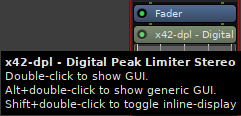
…and if in doubt… right-click somewhere 
1 Like
And just a small addition to this (sorry for using the Ardour forum for Mixbus tips, but here we are with this thread):
As a Mixbus user for many years, I realized just a few days ago that the channel EQs, Gates, SSL compressor actually have presets if you right click them 
4 Likes
Thanks Robin. Thats a good idea about hovering, I must admit I havent done
much of that. When i hear about something I usually start a new session
straightaway and just try out the one thing, so hopefully I don’t forget
about it. There’s so much to remember, even just what you feel needs to be
done on the song itself!
This topic was automatically closed 28 days after the last reply. New replies are no longer allowed.