Short of playing it, you can use the patch selector from the MIDI track’s context menu.
I don’t understand what this has do with MIDI bank/patches.
My fault. I thought any command from the transport section would be MTC. Must have got that wrong. However… I could swear my old Korg Electribe would send MTC and I had it coupled with Ardour 2.x back then. Might, of course have been MMC, not MTC. Or SMTP, RTCP, RunDMC, LCD or 123. I tend to lose it with all these TLAs.
There is something else regarding this that should be pointed out:
Whether the musical output of midi editing / midi sequencing style composers is of utmost brilliance or not, there is a group of musicians that can’t afford to have a midi keyboard handy (or whatever other devices may offer better ways to bring your ideas out compared to mouse + keyboard).
I only finally got a desk that has a drawer for a midi keyboard that finally enabled me to compose by playing the keyboard in the last 2 years or so after some 20 years of composing on my computer using the mouse and (computer) keyboard. Prior to that I just couldn’t afford a big enough setup to have a big midi keyboard next to it, nor any sort of drawer setup.
So there’s that, but there is also people on laptops, producing on the go, etc. For me I’ve probably produced half of my stuff over my life somewhere else than my home, and didn’t have access to even basic music equipment except again mouse + laptop keyboard.
As a sidenote, I much prefer a midi keyboard now, by far. But I just want to bring up that that’s not a possibility for everyone.
1 Like
I might have had a blind spot there because I was trying to do exactly that - scrolling through all the context menus trying to find a way to set a program number. Another problem was that I didn’t really have anything to select. No notes or events as I only had an effect on the MIDI channel that I wanted to set a specific preset.
Of course. Including me. You didn’t understand what I meant.
“We play, the computer listens and writes a MIDI score” is synonym of “We record MIDI”.
You are just stating the obvious.
Maybe you don’t know that the best DAWs allow you to edit multiple MIDI tracks at the same time, and treat MIDI track and MIDI channel as two completely independent concepts. You can have several MIDI channels on the same MIDI track and several MIDI tracks can share the same MIDI channel.
In any case, what you’re saying doesn’t make sense.
Again you did not understand what I was talking about. VST3 is an industry-wide standard for audio plug-ins. There is no equivalent today for MIDI plugins.
Also, MIDI does not date back to the 1970s but appeared in 1983.
Ardour allows this, along with the “better” DAWs.
Once again, the question is not whether this is possible, it’s a question of the preferred workflow of particular users. Some people HATE editing multiple MIDI channels in the same track, some people LOVE it. Try to convince them each that their approach is the wrong one …
I believe that nothing should force someone to edit multiple MIDI channels in the same track. And nothing should prevent it either.
Ardour is among the best DAWs.
1 Like
That’s correct, I’ve never used one.
Watching the video, I wondered why he didn’t just play the damn thing, instead of laboriously entering the notes step by step and one by one with the mouse. I didn’t get what he was trying to showcase at all (I admit I didn’t watch it all the way through).
Wikipedia says music trackers have a grid of fixed time slots. Looks like prison, visually and figuratively. But to each his own and that’s fine. Still, I don’t think trackers do anything that the best DAWs can’t do.
If you have any links or references, I’m interested.
Yet, most “classic” DAWs have elegantly solved these problems you raise in a way that is really useful to the musician.
I shouldn’t have talked about horizontal presentation. It is indeed a matter of taste and is secondary.
It is not at all my thing. For me, the fun is in playing and composing. What’s the point if an algorithm does it for me.
Brian Eno originally used and popularised the term ‘Generative Music’. He also explained in a famous video, which hopefully is still on YouTube, that ‘recorded music’ and ‘live music’ are not the same art, even if they are related. Just as cinema and theatre are not the same art, even if they are related. There is often confusion between the two.
VCV Rack is an amazing sound design environment and a terrible music creation environment. There is also often confusion between the two.
To go from ‘live music’ and sounds to ‘recorded music’, you need a virtual medium to place audio, MIDI and native automation items on a timeline. In music, there is a word for this: ’score’.
This is in essence what is the main window of a DAW. It is not a multitrack recorder. It is a score.
Nothing new. A score is not limited to the notes within the bar, it has always also included the general structure of the piece. Since the 1940s, a score can include audio, thanks to Pierre Schaeffer and musique concrète. George Martin, King Tubby and techno use the studio as an instrument music, so automation is also part of the damn score.
Again, my point is that the very limited tools and concepts for recording are crude and insufficient for music composition in general, MIDI in particular. When you’re a music producer, you play, you record, then the real work begins.
This timeline score is machine-readable. It needs to be human-readable, as much as possible (hence the succession of bars to represent velocities for instance).
The “classic” DAWs all have a traditional score editor. It is not used for composing but mostly for preparing printed scores for orchestral musicians, when recording a film soundtrack.
Of course, Ardour does not need MIDI functionality at all if the goal is to record generative music or classical musicians who use traditional Western staff and notation. And this whole thread is moot.
OK, I used too strong a word. It is “extremely helpful” for MIDI representation. That or a better alternative which, AFAIK, has yet to be invented. Western music practice is irrelevant: that something new was not used before its invention is not really an argument.
I see the connection between generative music, Euclidean rhythms and ancient traditions of live music that do not even have notation at all, but I don’t see the connection with first-class MIDI.
You have to say whether you want Ardour to be a tool for recording ‘live music’ or a toolset for creating ‘recorded music’ (yes, there is always some live music in recorded music, that goes without saying).
What I meant was that you need the context to form a mental image of your work, manipulate it in your mind then make a decision (even if that decision is to global-search-and-replace on a word-by-word basis). And in particular cases where you don’t need the context, well, just ignore it. What can do the most can do the least.
Music styles shouldn’t be a consideration. The purpose of a professional music software is not to recreate what has already been created. It is to make musicians free and powerful, to allow them to explore new territories and create something new. Again, what can do the most can do the least. Pre-MIDI music styles are very well covered anyway, thank you for them.
Why Ableton Live has proved extremely popular with a generation of composers/producers has everything to do with the rise of live laptop music and the poor state of the competition at the time, especially the way audio was added to MIDI sequencers (buggy, instable code vs clean code, boring and rigid multitrack recorder vs. light improv and composition software).
Live offers two distinct workflows.
One of these workflows is being added to Digital Performer and Logic Audio. Its ancestor comes from the 80s and 90s: looped MIDI sequencers (hardware or software — Cubase, Performer, Logic, etc. were perfectly fine for that) driving the MIDI rig, with live interaction from us, and recorded on DAT or whatever. The song was far from finished and we still had a lot of editing to do. Fortunately, there is the other workflow…
The other workflow, which is absolutely that of the classic DAWs. It’s just that it’s imprecise, incomplete, half-assed in Ableton Live. And it’s frankly quite similar between most DAWs I have had the opportunity to test or use. The real differences lie in what is missing.
Of course, I understand your caution and why you take any request or suggestion with a grain of salt. Absolute consistency is the hallmark of great software, the kind that musicians can learn and master.
This is how 99% of urban or electronic music that has been released since the introduction of MIDI was created, and a good chunk of the rest…
And to be perfectly clear, MIDI is mostly played and improvised with keyboards and controllers. The software write (aka record) the MIDI (the software inside MPCs do that too). Mistakes are edited in the software, transformations that can’t be done while playing are done in the software, the song is structured in the software, including what was recorded in audio and native automations (which sometimes are MIDI driven or are actual MIDI as in Reason).
That’s how most professional producers work (that would include me). The rest is the spectacle of music (in Guy Debord’s sense).
I don’t believe that this is true, given my definition of “direct MIDI editing” - that is, using the GUI of a DAW/tracker to individually create and manipulate the composition.
Most “urban or electronic music” is created using generators (drum machines, bass sequencers, pattern sequencers), loops (audio/MIDI), groove templates and … people banging on APC/pad-adjacent devices. None of which looks like “direct MIDI editing” as I defined it.
Although Live’s clip launching has some superficial similarities to MIDI sequencers of the 80s and 90s, it is fundamentally different in so many ways that I don’t find comparing the two of them useful. It’s a bit like saying that additive synthesis has FM synthesis as its ancestor, which is vaguely true in some hand-wavy senses, but ends up conflating two things that are actually wildly different (both in implementation and in usage). I know Gerhard (one of the founders of Ableton) and have chatted at length with him about Live’s origins and goals, and it was absolutely not driven by memories of the golden age of Windows/macOS MIDI sequencers.
And yes, it’s precisely the oft-cited weaknesses of Live’s “arrange” view that led me to mention it. Nobody who knows what they are doing buys/uses Live for the arrange view. It’s an afterthought. And yet, there it is, appearing all over the place, probably the most popular computer composition environment ever.
This seems slightly historically revisionist. Most of the “classic” DAWs added score editors long after they reached their position in the “field”. They vary in quality / ease of use quite significantly if someone like Tantacrul is to be believed.
1 Like
I have no problem with someone saying “I’ve never heard any music I like made with Rack (or modular synthesis in general)”. That’s very different from saying “it’s a terrible music creation environment”, which comes dripping with subjective and culturally specific assessments of what music is and should be.
I have to stress that I don’t like this music. But it is (to me) completely mind-blowing that it was created using a Tracker:
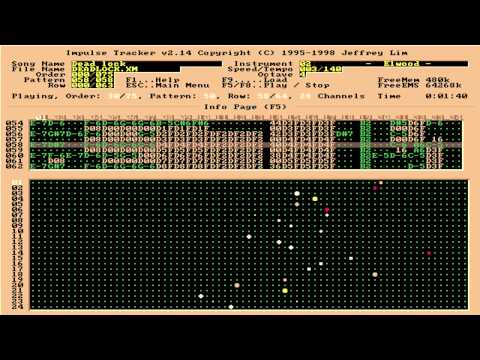
Apparently, nobody knows who Elwood was/is. He left behind 15 “mods” and vanished:
https://modarchive.org/index.php?request=view_artist_modules&query=69004
2 Likes
When I listen to classic Berlin school electronic music, I’m struck that few people seem to do much with contemporary technology that the Berlin school didn’t manage to do with 16 step analog sequencers, constantly de-tuning modulars and monophonic synths. So I don’t think “X can’t do anything that Y can’t do” is much of an argument.
Again, it’s all about preferred workflows and preferred outcomes. What’s a better tool for a given artist working on a particular piece …
If you think that generative music is about algorithms, I think that’s mostly just proof that you haven’t dived into it enough.
“Algorithm” is a bit of a weasel word, certainly in 2021. If you use any computer audio/music tools, you’re using “algorithms”.
Generative composition is about finding processes that unfold in pleasing ways, either alone or when combined with others. You’re working with timbral transformation as much as melodic and/or harmonic progression, and you tend to be working explicitly with relationships between parts in ways that is more emergent in traditional composition. As Reich wrote:
The distinctive thing about musical processes is that they determine all the note-to-note (sound-to-sound) details and the overall form simultaneously.
I am interested in perceptible processes. I want to be able to hear the process happening throughout the sounding music. To facilitate closely detailed listening, a musical process should happen extremely gradually.
Performing and listening to a gradual musical process resembles: pulling back a swing, releasing it, and observing it gradually come to rest; turning over an hourglass and watching the sand slowly run through to the bottom; placing your feet in the sand by the ocean’s edge and watching, feeling, and listening to the waves gradually bury them.
Though I may have the pleasure of discovering musical processes and composing the musical material to run through them, once the process is set up and loaded, it runs by itself.
What I’m interested in is a compositional process and a sounding music that are one and the same thing. While performing and listening to gradual musical processes, one can participate in a particular liberating and impersonal kind of ritual. Focusing in on the musical process makes possible that shift of attention away from he and she and you and me outward toward it
That was … a DOS based tracker? Wow. I’m truly floored. I would have loved to have seen an interview with this guy to see what his process for making such a complex track was.
As far as the MIDI functionality, I think Ardour does well for live performance type MIDI synthesis; where it slows down is manually entering every single MIDI note (like I did for Marmalade … I do not care to go through that ever again). The things that were the most time consuming were not placing the notes but editing each note’s velocity to make the drums and bass feel more human.
1 Like
Nonsense and journalistic clichés. A lot of work with the piano roll and the timeline in the studio.
Don’t believe the hype and the story telling. CDM is a great source of info about music tech and the industry, but totally irrelevant when it comes to music.
Hardware sequencers are completely unsuitable for entire genres of urban or electronic music. The only bass sequencer that had an impact is the TB-303. Banging on APCs is mostly on stage or on Instagram (and wasn’t available the 2/3 of the period we’re talking about). Pre-made loops are for non-musicians and hobbyists. ‘Grooveboxes’ (in the strict sense) are for newbies. ‘Groove templates’ were first introduced in Cubase for Atari.
You jam with your boxes or with Ableton Live’s clip mode to find ideas. Then you use the timeline to actually produce the track: work on its structure and on the transitions, do the sound design via automation (including via MIDI), develop melodies and chords, record instruments and vocals.
Thanks. His name rings a bell. Interesting bit of history.
Apparently, nobody knows who Elwood was/is. He left behind 15 “mods” and vanished
This is getting off topic, but Elwood didn’t really vanish. You can find more recent work here:
1 Like