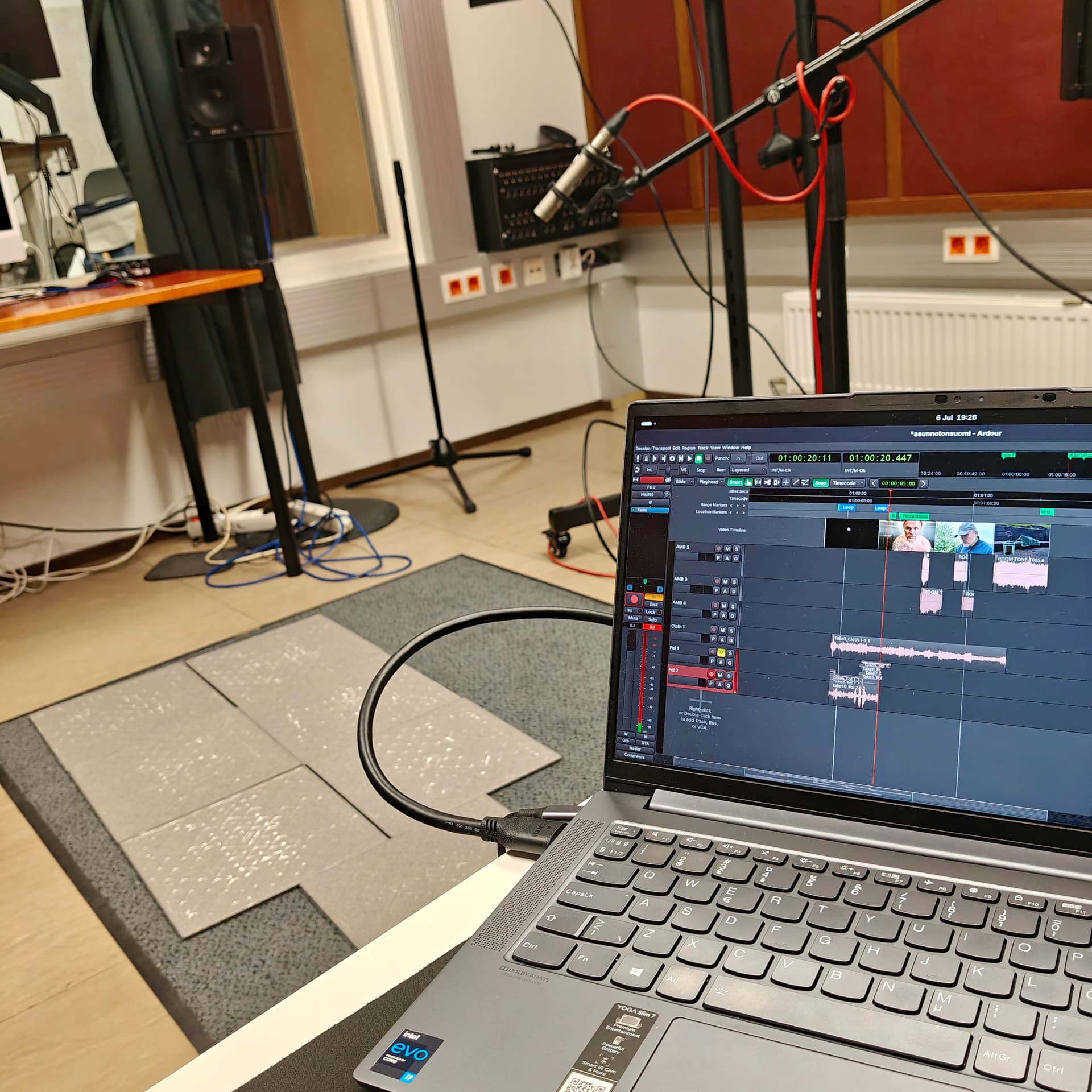
I’ve taken it as a challenge of mine to point out that you can in fact create a whole multichannel film soundtrack with Ardour from the beginning to the finished files. I’m going to even limit myself to only using the open source plugins.
I am currently working with my Linux laptop and what my university campus can provide. So far I’ve managed to get 12 channels out for 7.1.4 configuration to the Avid HDX and MTRX system using DiGiCo’s UB MADI. I even managed to get the Avid s3 and Dock working with Ardour. I’m currently writing a paper on the technical differences and compromises you have to make when working with Ardour instead of Pro Tools. Later this year I will write a thesis about how it is to edit, mix and master with Ardour and all open source plugins.
If you have any experience or know anyone who has created multichannel soundtracks for movies with Ardour please do let me know. Otherwise I’m happy to answer questions and share my experiences so far. The finished shortfilm will come out in the beginning of next year 2027.
Ardour is, as I think you know, an open source project, and we welcome feedback and input from our users. Rather than write these documents as if the state of Ardour is fixed in stone by some unresponsive corporation, it would be great if you’d let us read draft copies of these documents so we can assess if there are changes that we want to (and can) make to remove friction.
Wow, sounds like you has as much fun as I did 20 years ago. Short film soundtracks were the reason why I first got involved with Ardour.
I only did sound design, foley and basic stereo mixes though. Not the final mastering and 5.1. These days I’d probably use Ambisonics to do a multi-channel mix and then fold it down to 5.1 7.2.4 etc from there.
I get what you are suggesting but that would not go well with how I’m writing the paper and would also question my objectivity as a writer if I let others read and directly influence the text. Also it is in Finnish so it would be bit of a hassle to translate it.
I do understand very well that Ardour isn’t set in stone but I have to select a version that I work with throughout the writing process. I am planning on publishing this paper I’m writing before the actual thesis so you’ll have a chance to read it before I fully start doing the short film. And I am not as forced to limit myself to just one version of Ardour whilst working with the short film, so you’ll have plenty of opportunities to bring forward the good and the greatness of the community!
20 years is a long time and a lot has changed since. I am currently trying to figure out if I will choose the ambisonics path or if I stay on plain channel based solutions. I would love to use IAMF for object based audio, but as for now it only works with Reaper, unless some magic happens
Very interesting, I’d like to know more about your experience using Ardour for post.
You wrote Avid HDX… does this mean you used PT to create the Atmos mix - more like a tape machine, and Ardour to premix to those 12 channels?
I haven’t actually used Ardour for post yet at all. My thesis is going to be about trying it for audio post. I’m not going to use Atmos. Also there is no need to use Pro Tools, the HDX is only for communicating with the MTRX to set the source to the MADI profile. Object based audio has at least two FOSS projects going on AOmedia’s IAMF and EBUs ADM Renderer.
I found some issues related to while creating a session from an AAF made with DaVinci Resolve.
When creating session based on AAF the video file doesn’t get automatically imported to the session. Also when using the “open video” function, it always inserts the video at TC 00:00:00:00 even if it has LTC embedded in the metadata.
(Couldn’t find a setting that would change the start of the timeline either. It’s a standard in the field that the first frame of the video starts at 10:00:00:00. When importing files from AAF to Ardour that uses this standard, it creates an empty ten hour long section to start of the timeline)
Edit: confused myself by remembering the start frame was at the tenth hour instead of the tenth minute…
One missing feature is to separate the length of the clips in the AAF and the length of them on the timeline. Using frame extensions on the audio clips makes the ends have more space but for some reason Ardour doesn’t import the clips in full, just the region that was set on the editing software’s timeline.
Otherwise I haven’t found anything deal breaking while testing with Ardour.
No surprise there. Ardour’s AAF support is experimental, and very limited. Given the shitshow that is AAF, I’m always surprised that it works at all
Video start offset is honored if that is in the video-file header itself.
Alternatively LTC can be used if the first audio-track of the video file contains a LTC signal
(LTC is not meta-data, SMPTE timecode data in an audio signal, commonly used to sync A/V). Try to import without extracting LTC.
After bit of a radio silence from waiting for the editor to do their job I was finally able to start working on the first short film. Recording foley seems to be a breeze on Ardour. Especially since you don’t have to remember to enable recording to a playlist.