I’ve been thinking about remastering/facelifting my first ever tracks from back when i started producing (2001-2002…? can’t remember exacly), and about doing it in Ardour.
The originals were all done in FL, in some version when it was still called Fruity Loops…and i haven’t kept project files (back then i had no experience, haven’t even crossed my mind to archive everything properly). So, only CD quality master wavs are available.
Music ranges from something that reminds of Enigma, Moby to something Prodigy-like (but with fl’s '80s kind of sounds ) all with present DnB influence.
Masters are here and there muddy, some are over-reverbarated, and in some tracks there is noticable distortion on busy parts.
I was thinking of not messing with stem separation (i don’t wan’t to introduce new&bad artifacts), but using traditional tools instead + layering some new drum & piano sounds (maybe sythesised) on top of the existing ones where necessary, mostly because they lost their impact because of over-reverbation.
I’m not super experienced (ie. professional) in remastering things but I have a few ideas. Apologies if I’m telling anyone how to suck eggs here
Muddy mixes can be helped with some dynamic EQ if there are things that stick out a bit too much and you want to limit certain boomy notes or similar resonances - usually between 150 and 500 Hz or thereabouts. You might be able to do something similar with multi-band compression instead and focus in on that region.
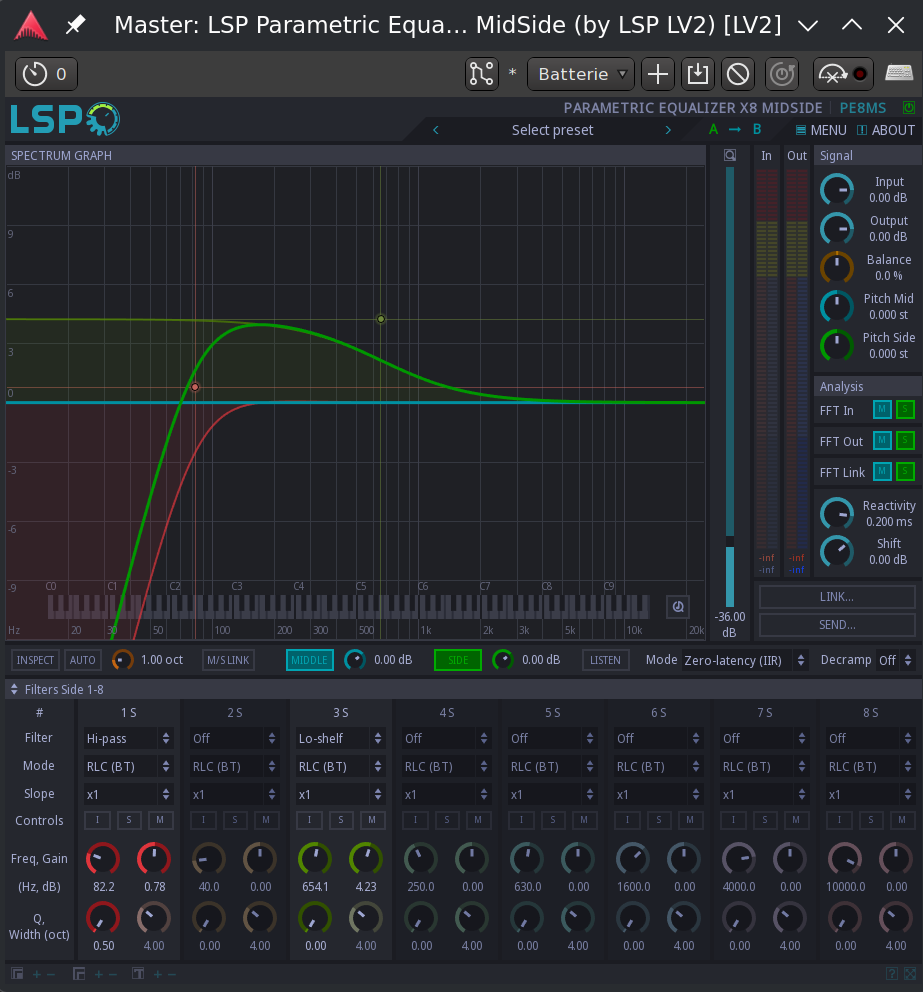
Removing reverb is tricky but perhaps you can reduce it a bit at certain frequencies by using a mid-side EQ, I use the LSP Parametric MidSide plugin. You can cut frequencies in the side channel to reduce their stereo spread there which you could try on, say, a particularly reverby snare drum or something like that.
I have been remastering some old DJ mixes that were recorded from vinyl and I’ve been using the same M/S EQ to remove very low-end “side” channel but also put a small side boost between about 100 to 600 Hz which has a subtle effect on widening the stereo a little bit in that range. Looks like this:
You could try notching out some of the problematic drum parts and add new ones over the top, if you can get it all synchronised nicely. But hard to do without notching out everything else as well
But to REALLY fix it, you might have to resort to some stem separation. I have found the HQ separation in moises.ai (others are available) to be pretty good and the artefacts that you do hear on the separate stems do seem to blend back together and cancel out when you start mixing them all back together again. I recently used this on a live recording I made years ago where I’d pre-mixed four different instruments down to stereo (I didn’t have enough tracks at the time) and it separated them out again pretty well!
I didn’t start yet, cause i’m treating that as something i’ll eventually do and re-release it prior to the release of the new (comeback) EP of the same project, while at the same time i’m transitioning the whole workflow for my personal projects to Ardour on Linux.
I was just editing some .sfz’s i need for half of a day yesterday . Mostly i’m gathering samples (creating personal library) and checking out instruments&plugins for entirety of my free time these days. On Windows, back when i started i used Fruity&Cool Edit in combination, then Reason a short time (an year the most), then i transtitioned to Cubase, which i’m most acustomed to. Getting used to Ardour goes slowly, not only because of the daw, but the plugins and also the OS. Also, there’s the fact that whenever i learned new things in the past i basically had entire days of free time, and now it’s an hour here, hour there.
Maybe i should mention i’m this weird combination of guitarist, drummer, vocalist, punk-rocker, edm&pop&all around music lover, ex-pc&self-service&medical lab tech service technician, tv/radio/digital advertising mixing engineer&sound technician that also finished film&tv school (film&tv director) and occasionally work as a live mixing engineer or sound tech mostly in clubs or small fests ž, husband and the father of two…so…maybe i have high expectations for having more free time…
I used FruityLoops back in the day, 2002-5 or thereabouts. I had fun with it and made some trancey housey tracks but never did anything with them, I’m tempted to go back and fix them up a bit.
I too switched to Cubase after a few years of not doing any music production work but also experimented with Ardour. I still use Cubase for big projects with lots of MIDI and large sample libraries and so on but for pure recording projects (live orchestras and other groups and ensembles) I now use Ardour, and I’ve also switched to it for mastering.
About the same with me…i used FL somewhere from early 2000’s to about 2004. From that period i have 3 “albums” left. First one is the 14 track thing i already talked about, and two more which are just some atmospheric music made for City Theather(basicaly, ngo-funded amateur theather of young people) done with FL,CoolEdit&Reason interchangeably. After that i kind of lost interest for electronic music in general and wandered off to live music completely, but lately, i have this reccuring interest in it…and not only interest, but i have some new melody&song arrangement ideas clearly aimed at dnb, edm and similar.
So, i was thinking…let’s remaster that ancient album and slowly but surely make a new one, no pressure. It’s not like i’m dying to see the crowd from the stage, i just have some cool stuff i need to get out of my head.
Also, it’s not realy fun to me to do it in Cubase…but to do it using Ardour&Linux sounds like something i’d do just for kicks.
Working only from the CD masters, I would aim for better tone and balance rather than trying to undo the original mix. A few things help. Import the WAVs into a session and keep an untouched copy on a separate track, then loudness-match the two whenever you compare, because the louder version nearly always sounds better at first. Muddiness usually responds to a broad, gentle cut somewhere in the low mids more than to a narrow deep one. Reverb that is baked in cannot really be removed, but a little downward expansion or a transient shaper can make the tails feel shorter. Where the distortion comes from clipping in the original export, avoid pushing a limiter harder on top, as that tends to make it more obvious. Work at 24-bit and only dither on the final export.
 ) all with present DnB influence.