To the Ardour Development Team,
I am writing this letter as a professional composer, photographer, and videographer. Recently, I decided to leave my commercial subscription with Studio One to embrace Ardour, drawn by its outstanding open-source philosophy, rock-solid audio engine, excellent video synchronization via Harvid, and native timecode locking capabilities.
However, after attempting to integrate Ardour into a real-world scoring workflow, I encountered a major obstacle that makes daily composition extremely difficult: the rigidity and UI constraints of the Tempo Track.
In modern film scoring and production, musical expression relies heavily on human feel—micro-rubatos, organic accelerandos, and freehand tempo adjustments. In Ardour, handling tempo changes feels unnecessarily rigid:
No freehand drawing or flexible tempo curves: Having to rely solely on discrete mathematical nodes and linear ramps for every small expressive nuance kills the creative flow.
UI limitations: The inability to vertically expand the tempo track on the main timeline to work on a comfortable visual scale makes fine editing on a thin ruler very frustrating.
Looking through the official forums and feature request trackers, it is clear that I am not alone. Numerous composers have repeatedly asked for a more flexible, expandable, and drawable tempo management system. Unfortunately, the response from the development side seems consistently negative, often dismissing these requests in favor of rigid architectural dogmas about discrete nodes.
We understand and respect the engineering precision behind Ardour. However, when software refuses to adapt to the natural, gestural workflow of musicians, it creates a barrier to entry that no technical stability can overcome.
Many of us are eager to support independent, open-source software and leave behind expensive commercial subscriptions. But if these fundamental usability requests continue to be rejected, composers will simply be forced to take their time, projects, and financial contributions elsewhere—towards platforms like REAPER or back to commercial DAWs that accommodate these workflows.
We sincerely hope the development team will reconsider its stance on tempo editing and prioritize human-centered tools for composers in upcoming releases.
Sincerely,
We do not believe that you actually need or want to freehand draw curves.
We suggest that you watch the Harrison Mixbus video on “tempo mapping”, which will explain how we handle “human feel”. We believe we handle it better than other DAWs, but not in the way you are expecting.
Ciao caro, ti ringrazio per la risposta.
Due problemi:
personalizzazione della tempo map, lontana da un bpm rigido (io mi occupo di film scoring e musica classica e un bpm serrato non è tipicamente stilistico)
libertà di lavoro sulla tempo track, personalizzazione estrema a vantaggio del risultato musicale.
ti prego, lavorate sul problema per risolvere questo aspetto del lavoro su Ardour
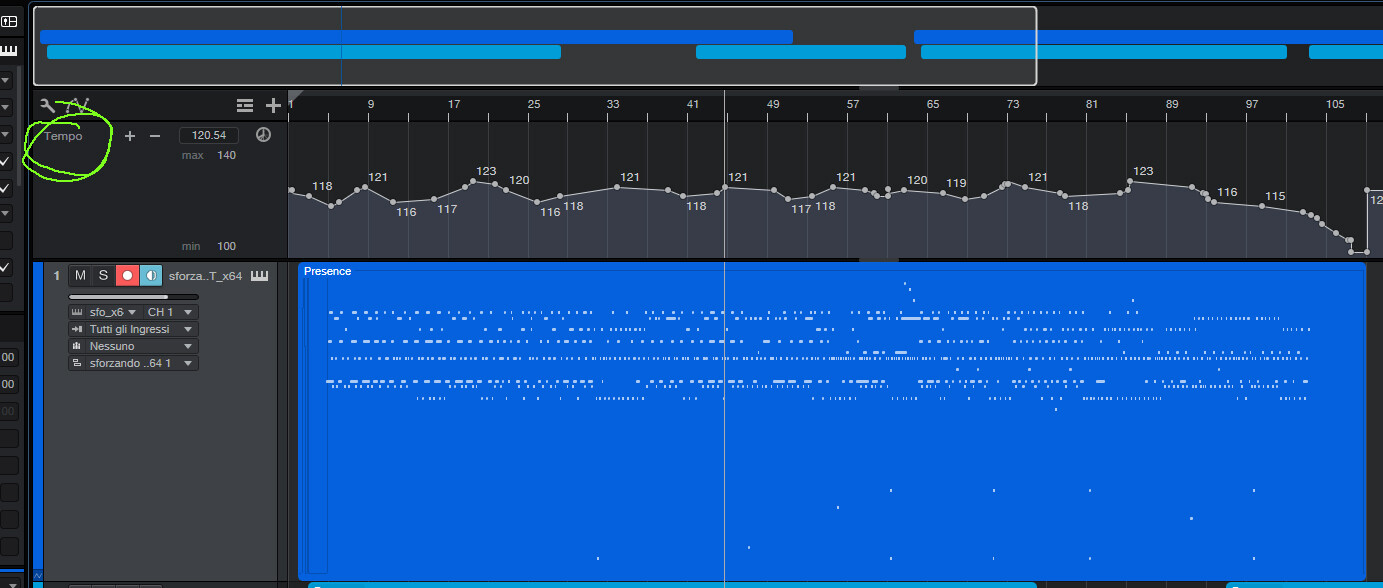
allego una immagine per mostrarti il grado di personalizzazione che solitamente uso sulla mia tempo track; quindi si… HAI BISOGNO DI CREDERE che mi serva disegnare a mano la traccia del tempo
I do not understand. Ardour can do all of that. The only thing I can see that I think you want is the ability to drag the dots up and down to change over a large vertical range …
Da docente ti dico che questa funzione non è “andare su e giù col mouse” ma una funzione importantissima per la gestione del tempo, velocissima e capace di farti capire immediatamente cosa sta succedendo e dove. Perdonami ma si vede che non hai esperienza nello scoring di lungo metraggi e Sync continua, questa funzione velocizza e programma immediamente la traccia. Quando hai da gestire 60 tracce di orchestra, droni e suoni d’ambiente per due ore, ti assicuro che non hai tempo per pensare a tutte quelle filosofie da nerd. La traccia tempo in Ardour non si vede nemmeno, con un po’ di presbiopia ti perderesti
I didn’t even know that something like this existed until now. It looks very cool/handy though, for quick, organic adjustments. I have that song from earlier this year (-with all those ‘crazy’ tempo and time-signature changes, if you recall) that could probably benefit from something like that. -An expandable tempo lane of sorts.
Although, to be fair, I first need to start dabbling with the use of the Grid Mode as Nathan mentioned in that video! It seems like a great tool. Don’t know why I didn’t start using it earlier…
Il video di mixbus è usato principalmente per imbrigliare una traccia suonata senza tempo. In studio One, una volta trovati i riferimenti del BPM, puoi cambiarlo a tuo piacimento e ricostruire una nuova griglia con i transienti impostato sul BPM del tuo progetto. La scrittura del tempo in modalità più libera aiuta a rimuovere l’effetto serrato della musica quantizzata