Noise experiments with ardour and shortcirtcuit

I hesitated for quite a while …:
What i do i call “noise” or “experiments”, it sure isn’t music. That is what i want and like to do, but it is for my own pleasure only, though of course i hope one or two others might at least like the general approach Mixing i got really hard times, i start with bad, and the more i fiddle, the worse it gets, it seems. Then i listened to it for too long, and just leave as is.
So, you know what you’ll run into if you click. Noise.

4 Likes

If this cannot be called music, then some finest works by Stockhausen, Cage, or contemporary “noise” artists should not be referred to as such either. I’m certain that musicologists wouldn’t agree with that.

And this was a good decision, because the mix sounds very good to me. Although I get the impression that it was mixed on (or for) headphones, since it loses some of its “bite” when played back on monitors. That’s something that could easily be fixed during mastering.

But this is a minor complaint, because I really liked the piece. Great work!

1 Like

Thats very kind, and it is nice you liked it.

Regarding “mixing” or “mastering” (i wouldn’t even know the difference …): You got no idea how strange the whole topic is to me. And often enough i don’t do anything at all. A few bars and i loop over it, but no changes in volume and sometimes not even any additional effect plugin on top of a synth at all (in general i hardly use them). I think i just abuse ardour as a sequencer like seq24, so i don’t have to hit the virtual-keyboard or the midi-keyboard.
I tried to watch tutorials about “mixing”, but it seems like a really huge topic … I will try it again during the winter to come.

And yes, i think i really mainly used headphones (night !) . If you got an idea what to change, you said it can be easily fixed, i might give it a try.

I am quite a fan of John Zorn, but the really wild stuff. Stockhausen and Cage i know, of course, but not good.

Thanks.

In a nutshell

“mixing” is adjusting the levels (and things like compression, EQ, effects, etc.) of individual tracks against each other.

“mastering” is taking the final mix and adjusting the whole track’s EQ, compression, etc. to create a final product.

Often mastering has a particular target which, historically, could be for vinyl, cassette tape, CD, radio-play, etc. as different media have different requirements. For example, mastering for vinyl is important because vinyl has some significant physical limitations, such as too much low-end causing the needle to skip on playback. If you are interested, here’s a good guide:

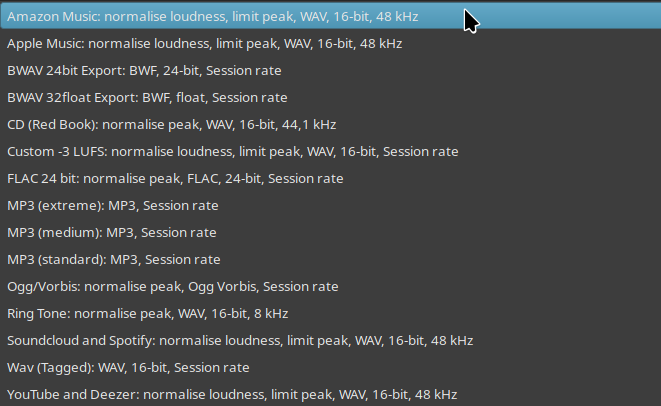
For modern music distribution, mastering targets are using things like Spotify, Youtube, Apple Music, etc. as some of these have different requirements. Ardour actually has a bunch of pre-canned settings to accommodate different “loudness” profiles for different media, as well as different physical format.
image

“Loudness” is an important part of modern mastering, but it’s not the whole story, mastering covers a whole lot more. You may, for example, want to also change the EQ to suit certain listening scenarios (e.g. someone listening on a car stereo whilst driving) or you may want to make other “artistic” changes, such as boosting the overall level of the final chorus slightly.

That’s really a high-level overview. Mastering is a complex subject and there are whole books written on the subject.

But hopefully that’s enough to understand the primary difference between “mixing” and “mastering”.

Cheers,

Keith
1 Like

Thanks a lot for putting that much time and energy into explaining it to me.
I’m gonna chew on that info for a bit. It helped quite a bit.

1 Like

What matters is the end result, not how you get there. If you’re happy with the outcome, it means you’re not abusing anything.

I meant that there’s no need for any major changes, just some small adjustments (like a bit of EQ here or there, maybe some compression), which are typically done during the mastering stage once the mix is ready (and @Majik gave you an excellent explanation of what it is for).

However, I wouldn’t start tinkering with it just yet if you don’t know exactly what you’d like to achieve. The track already sounds good enough as it is.

2 Likes