This is a fucked up feature! I think that IIRC there is page in the documentation bragging about how ardour was designed to get musicians recording. Every time I open ardour 10 mins is wasted playing with the inputs and outputs to remove this light!! There needs to be a clearer solution! No logs to say what is wrong, and even if they are there without it being BLANTANTLY overt the musicians wastes time! time is every thing in music
The no-align light comes on when you change the signal routing to create more than one way for the same signal to arrive at the same place, with different latencies.
If you don’t mess with the routing, or if you understand why this sort of routing is a problem, then you’ll likely never see it.
For many (most?) users and most (many?) workflows, Ardour’s default routing is all you need, and there’s no need to adjust it.
2 Likes
Which is why the feature needs an upgrade. The light should be clickable and show the aberrant routing. Having the user search the routing is not ideal. Less things to remember means more creativity and routing should enhance the listeners experience, and it should be easy to use!
1 Like
Why are you changing the routing?
In many cases, we’ve found that users get routing into such a state that we cannot even tell them in any simple way what is wrong.
Ardour is designed like Unix: enough rope to shoot yourself in the foot. We’re not here to hand-hold people through what they ought to do (and ought not to do), we’d rather make hard things easy and impossible things possible. We do try to choose defaults that will work for most people a lot of the time.
3 Likes
Why wouldn’t I change the routing? In most standard mix techniques you establish busses via routing. There isn’t anything special about this. It is just supposed to work.
Anyways the point stands that is should be easy to understand when something goes wrong. Isn’t that unix philosophy? Do one thing and do it well? I don’t understand why having a feature to click on the light to see what the problem is in the routing would particularly diverge from that principle. Maybe I should relabel this thread.
This is a forum, if you know solutions please help. I’m a human being trying to get stuff done
The culprit was JACK. If ardour could for warn the user via the suggestions I’ve mentioned above it would be a great addition to an already awesome software! Thx for reading
1 Like
Yes, the overall idea of Ardour automatically doing some kind of ‘basic’ route comparing and at least giving the user some basic, initial glimpse at what route(s) might be causing the ‘No Align’ light to be lit is obviously a fine suggestion, and would be a welcome convenience.
Feel free to create a second login, and submit it as a ‘feature request’ using Mantis, here: http://tracker.ardour.org/ 
(What do you mean by “default” exactly? -Direct connections to the Master? … -Those are too simple!  )
)
These comments about routing confuse me. The latter (to me) is almost like saying ‘Why are you editing audio regions?’ : P
Routing is very, very important, and can oftentimes get quite complex based on the signal flow you wish to achieve. Obviously keeping things as ‘linear’, ‘logical’, and consistent (-from group-to-group as well as project-to-project) is ideal in terms of better understand-ability. But sometimes certain situations ‘demand’ pretty damn ‘odd’ routing.
I for one have spent several weeks honing certain track/bus signal flows/templates, and they typically involve ‘many-to-one’ and ‘one-to-many’ connections, and heavy (basically exclusive) Aux Send use. For the record, I have thus far only encountered one project (-out of 16 total projects-) where the ‘No Align’ light was lit. But I’m confident I can pinpoint why it is, and will get rid of it. 
-J
Maybe some kind of reset option or button that removes the “No align” situation.??
If someone doesn’t know what they did to cause a no align, then they were likely not paying attention when the light started flashing. So, maybe an optional pop up window to be clicked away when it is switched on might be a less subtle indicator.
2 Likes
No align indicates an ambiguity (usually caused by one to many connections). So the problem is that Ardour would have to read the user’s mind to find out which solution they want.
The log windows indicates which ports are affected, and hence can provide clues as to how to resolve the situation.
–
PS. Ardour intentionally allows this and also temporary feedback to cater for live mixing situations. This way you can first make a connection (which may cause no-align),and then disconnecting something else. This allows for seamless transitions.
2 Likes
I agree. But my only complaint is that this is non-obvious. When I have had issues with “no sync” it took time for me to work out that the log provided this information. I think I mainly found out through searching forum posts. If it is in the manual, I couldn’t find it (and even if it is in the manual somewhere, it’s not ideal to have to dig around the manual to find it).
A nice usability enhancement would be to have some sort of pop-up on the indicator that provided that information.
A much easier enhancement would be to update the tooltip text to say that the log contains more info. Longer term I would prefer to have the information directly from the indicator.
Cheers,
Keith
3 Likes
Oh, Ardour can’t read my mind? That explains why my tracks often stay at the demo stage 
2 Likes
To be fair to @croakouttatune (OP), it was in fact really annoying (-took about 20min) to track-down where my one instance of “No Align” was originating from…
Long story short, I had to duplicate my project, and then start deleting groups until it went away (-as merely deactivating them doesn’t do the trick, unfortunately…  )
)
Turns out it was the “Click out” set as the input for a single, simple, mono audio track intended to ultimately record the metronome:
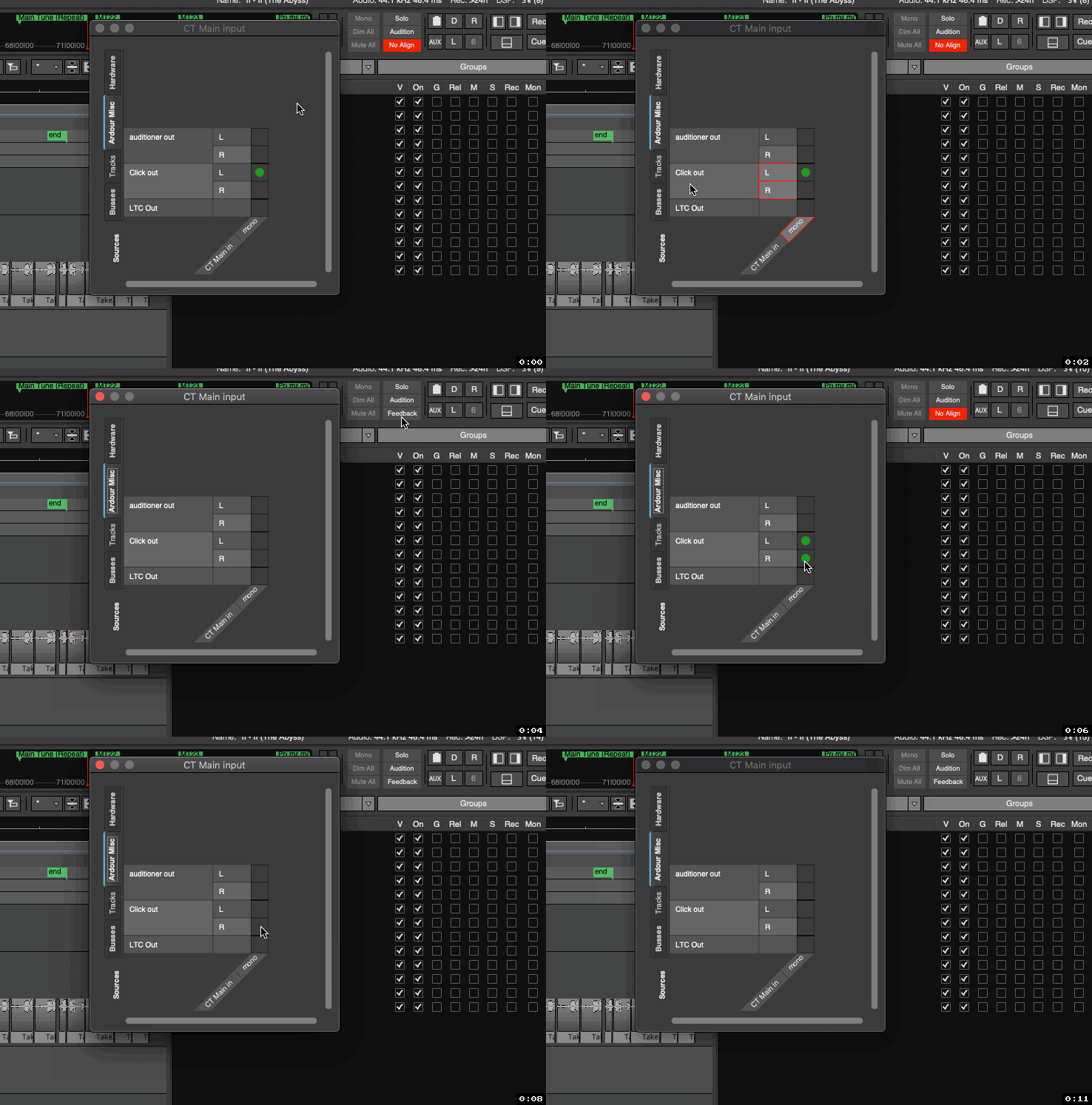
-_____- … 
 ~Great job!
In conclusion, and I know this isn’t anyone’s priority nor should be, but yes, being able to click the flashing button and having it give the user at least some clue about what or where the issue is would be very, very helpful.
Thanks for reading!
-J
1 Like
I experienced the No Align light recently for the first time ever and didn’t know what it meant. A quick visit to the manual enlightened me, and I solved in a few minutes by checking the log and changing the errant routing in the Routing window. No big deal.
The light certainly should exist. Having routes not aligned is detrimental.
So I can actually hear the click or the auditioner (export playback), usually.
This topic was automatically closed 91 days after the last reply. New replies are no longer allowed.