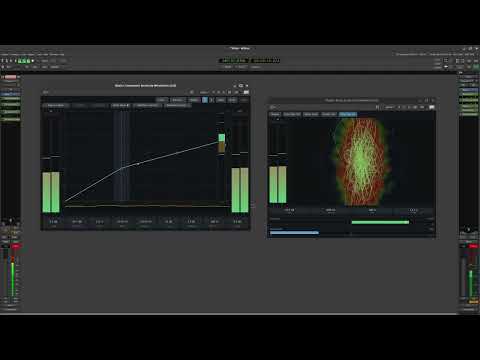
I’m not particularly proud of these plugins, since a lot of it is AI-generated. With my background as an electrical engineer, I have a general understanding of how digital processing works, so I was able to create a few plugins based on my own ideas. The fact that many of the really good plugins still aren’t available for Linux makes things difficult for me. In any case, it’s great to work with professionals who know the tools they need inside and out. I’ve found that small details like “undo,” A/B configurations, or “Save As” to create custom templates are sometimes essential.
However, the focus of the plugins isn’t on the underlying math but on usability. I’ve spent many days in the studio with my professional colleague, watching him work over his shoulder. I’ve been observing what he finds lacking in the plugins and what mine still need.
My goal is to get more professionals to adopt tools like Ardour and to help the community grow. My experience with plugins is still pretty limited. Feel free to take a critical look if you’d like. A few things are already pretty cool.
I’m still working hard on revising and testing it. A lot of it probably isn’t as good as it should be yet. It works for me for now, and I wanted to show it to someone outside my field of work. I’m curious to hear what the Ardour community thinks.
I’m going to (plan to) make a video over the next few weeks where I’ll try to show what I’ve come up with for the plugins.
I’d also like to take this opportunity to thank the Ardour community and acknowledge all the great work that goes into it.
I watched the video. Good work on the plugins and thanks for making them open source, Ai coding is the new standard, and AI is already used for coding inside professional coding houses. No shame there, its just the new way of doing things.
Usability of the plugins looks good and I will test them out. It would be nice to have something like these included in the Ardour package since I find some of the plugins included there a bit lacking.
AI coding is NOT “the new standard” and the fact that some people “inside professional coding houses” are using it does not speak to its qualities, appropriateness or fitness for purpose.
And, regardless of the nature of the code output, using AI demands that we answer questions about the implications this technology has for all of us, our homes, our communities and our planet.
I’m not here to tell anyone what their answers ought to be, but I am going to push back on any “oh well, AI is here now, everyone is using it, get happy!” angles.
I’m speaking from experience. My brother is a senior coder in a professional coding house and his main job nowadays is prompting AI and reviewing code it produces. He has been writing code there for more than two decades and everything has changed in about a year. He says that code writing used to be the bottleneck for getting new features out the door. Now the bottleneck is the people thinking about new features.
I know this is a touchy subject, but I was just stating a fact I personally know. Not trying to start a war here.
I take a very critical view of the fact that AI models draw their expertise from open source, which was actually intended to remain “free” through licensing, and that a workaround has been found in AI training to use open source to create proprietary code. On the other hand, I believe that open-source projects in particular can benefit enormously, precisely because they are open-source and AI can examine them in their entirety. Whether it’s standard practice or not, it has turned the software world upside down. Now we have to learn to deal with it (my opinion). The plugins are definitely designed to help people make good music and have good tools. I think my plugins are good tools, otherwise, I wouldn’t have released them. Unlike code written by humans, I don’t see my plugin code as a work of art. At most, it’s the implementation (design) of Contour, which was my own idea. Have fun experimenting. I’m especially excited to see what the community can do with this one (sound-wise).
Hi again,
I was able to make a few more updates. Especially to the limiter, and the graphics should be better now. I’m curious to see what others do with it. Feel free to let me know. I’m writing about another tool for which I just released a first version. I spent a lot more time working on that one. I’ve already made several attempts to fix the leaks where sound from one instrument bleeds into the wrong microphone. This is especially useful for post-processing concert recordings. But it’s also helpful for certain studio recordings where, for cost reasons, we often can’t rent a top-tier studio where each instrument has its own room. In my experience, this also tends to drain some of the band’s energy. Over the past few months, I’ve conducted several tests with my concerts and recordings. I’ve tried everything we learned at the university, Wiener filters, LMS, and spectral approaches, as well as my own ideas involving correlation measurements. The results were always very disappointing. Now, however, I’ve achieved very good results using neural networks, and I’m finally satisfied, we’ve got something usable.
Everything runs locally, and you don’t have to upload a single sample. Originally, I also wanted to integrate plugins into Ardour, but that wasn’t possible. The first algorithms had issues with sidechain lookahead, but now, with the neural networks, that’s no longer an option. There’s a feature that lets you import a session directly from Ardour. I’d like to add an export function later so the programs work well together. Feedback is welcome here, too. Apart from me, almost no one else has tested this yet, so it’s quite possible that some things still don’t work. I don’t have a Radeon graphics card myself that would allow for faster rendering.
Thank you so much for the Ardour contribution. Especially since version 9, we can now interchange channel strips much more quickly. I’m running out of ideas for what else we might need to work more efficiently. Ardour was my starting point for this. So thank you!