Yes, definitely. Liquorix can install on MXLinux too. I’m excited to try the Release Candidate for 19 as it will upgrade to final without any issues. I only chose AntiX because it can be installed bare-bones and is super responsive with low-resource GUI etc. I feel it is the perfect distro for my audio needs after the addition of the extra repos like KXStudio. For everything else, MXLinux fits the bill perfectly!
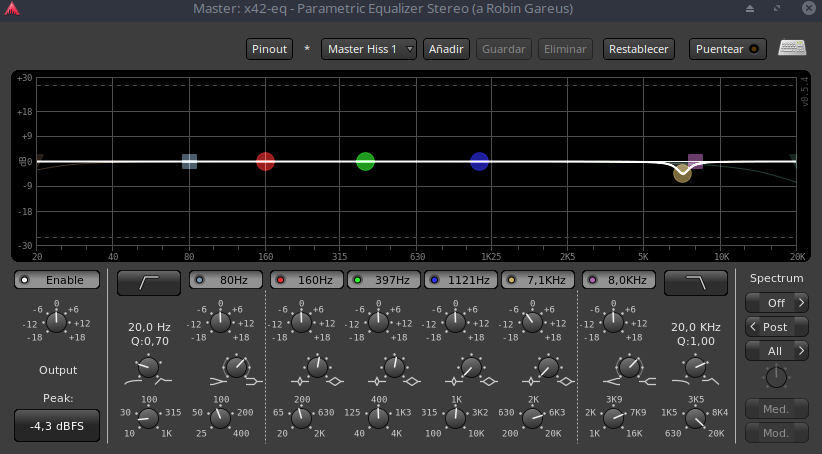
OK, after a quick listen I prefer the latest version for the notes I originally had issues with at least on the Altec speakers. Not in a position to try on KEFs yet as family is asleep. Judging by the x42-eq screenshot, these do seem like big EQ changes and something I’m not used to when essentially at the “mastering” stage of classical recording. Your original blended with reverb generally sounds great but I’d be interested by hearing just the “hiss” reduction as suggested by @vasakq and then just a low-pass in isolation as that will also help you understand what each is doing on its own terms. I have a feeling that the deep cut around 7k has both a wider Q and bigger dB drop than @vasakq suggested. I’d be interested what others think as I kinda want to split the difference and keep the majority of the original but with the tamed notes from the second. Also try experimenting with putting the EQ directly on the recorded signal versus on the reverb too. The other thing that crossed my mind while trying to sleep was that I don’t know anything about the room you recorded in and what effect that has on resonance etc.
Here is a new version only a cut around 7k
I just installed Antix19 but I have to deal with. The Fn keys are not working, the boot is long looking for eth0 and I have not wifi with the liquorix kernel… 
I work as a second bassoonist with the Zagreb Philharmonic Orchestra from Croatia. I like to record ensembles I am playing with and my friends musicians who need recording services and I sometimes even compose some music on computer. And, since I am Linux enthusiast, I use Ardour to accomplish all that. I have been using it since 2010, since version 2.x.
If I was in search for a new recording device (which I might be in nearer future since my equipment is ancient) I would also consider standalone recorders, especially now, when Sound Devices and Zoom have prices low enough for us, mere mortals. There is also a factor of portability. Actually, lately I have been using Raspberry Pi Zero W as my field recording (…tracking) computer (it is of a size of my thumb) just because I can carry it in my pocket. I can hide it anywhere (including middle of the stage), it can run on batteries (external phone charger) and it has got enough computing power for recording 2 channels for hours. Since I can hide it on stage I need to carry only 2x3 meters of mic cables (and no mains cables) and since it runs Linux I can control recording remotely from my phone via ssh or vnc. This is very important to me because when I do both performing and recording, I can have my phone on my music stand and thus check levels, start and stop recording. For such a simple task I use simpler programs such as ecasound, mhwaveedit or arecord. Running Ardour is possible, but I feel I am pushing this little device to its limits, which is never a good idea when doing long recordings.
Happy birthday!!
Two of us seem to have some things in common. Besides doing recording and using Linux (very rare combination where I come from), I am 40, my wife is a musician (solfeggio/harmony teacher, actually), and we too have two kids.
This version has much more HF content, but for some reason it feels more natural to me, or at least sounds more like the sound of flute I am used to. Of course both Eq* and Eq2* settings are subtle, analogue to moving microphones 50 cm back or forth. When you compare the two make sure to level match them because Eq 1 has some cuts which will make it somewhat quieter and thus less appealing just because of loudness.
Just to throw something else into the mix… In that Robert Toft book I mentioned he discussed dynamic EQ in a classical mastering setting. I wonder whether this would be good on these flute recordings with an ability to tackle any problem frequencies of just the louder notes? It has the potential to be the most transparent, I suppose, and maintain all of the HF content that @vasakq likes 99% of the time. The only thing I’m unsure of is if there is even a viable dynamic EQ plugin on Linux as I’ve never even thought to use it until now.
@vasakq
that’s some interesting detail with the rpi zero w
happy b-day too @anon60445789 – I appreciate the OP you created to provide us users with parallel tools we can use between these two systems – even though I don’t use Windows and will take me awhile to start using ardour/mixbus more effectively I might be able to dig a thought you provided and use a suggestion you pointed.
cheers
I suppose you are on Linux – yeah the RT kernels they use special patches which optimize IRQ and RCU things, I just compiled my rt kernel a week ago for 5.2.14 and it does make a difference in mitigating x-runs…
But you’ll also have to check your sched_* thing parameters and throw a few tinkers against /sys/kernel/debug/sched_features to fully mitigate them.
I went through 4 or 5 kernels the last couple of weeks and it wasn’t until I started using sub 1ms things for sched_* that I was able to fully eradicate like 99% of my xruns…
and the answer is yes it does make a difference… 
more ram wouldn’t necessarily help but faster ram can help though I wouldn’t set a bet on it, I’d look first towards getting an RT kernel and trying that first…
ubuntustudio and avllinux both use the same scheduling parameters – you’d be surprised you can get the same latency results with other distributions, it’s a matter of knowing where to set the changes… To me distribution is irrelevant, it’s more about knowing where distros generally make their changes. not to bicker about it – I have linux cert things, and have been using Linux for over a decade… so I’m used to nitty-gritty things… I follow lkml, lf news… so I’m very much into linux here…
Thanks! I must say I don’t really get the differences for audio performance these days between low-latency and RT other than the various forums I’ve read suggested low-latency over RT (and couldn’t remember the reasons!). Running Liquorix or any other low latency seems to be just fine for me but I might be missing out on something! It’s always good to get the system running as efficiently as possible so if you consider RT still the way to go, I might give it a try…
I’m actually studying for the Linux Essentials exam (hopefully getting my daughter involved too!) and then the more serious LPIC stuff but know next to nothing about kernels and audio performance…
I’ve used Linux since about 2002 or 2003 (can’t remember precisely but I downloaded a SUSE linux net install in the music library at UNC Chapel Hill  ) and have been using Ubuntu-based distros for day-to-day tasks as my main OS for a good number of years. I’m now on MXLinux and AntiX. Linux audio has been a relatively new venture in the past five years but it is already my primary mode of operating for everything but classical editing and restoration work.
they’re starting to roll in systemd competence into the LPIC certifications – so don’t listen to users when they brag that “systemd” is evil :)… Here I’m heading for the RH openstack certs – I’ve got LPIC-2 (and I could go for LPIC-3 if I spend time for it) – I also have basic cisco ccna, but I really should have ccnp as it is better on a resume. If you have a family member trying to get into linux, they should also be getting network certs along the way as that definitely help. The phone companies are embracing openstack for their networks, and so definitely openstack to me is a very promising to set foot in as a career path… The doors become open with network certs, RH was just bought for 34 billion by IBM so you can be sure you are heading into the right direction when considering Linux and openstack.
Edit: Also if you read up about all the other news around Linux, MS has started developing more for Linux.
They used to have 25% of their Azure customers using Linux, that went up to 50%, it is probably higher at this point.
If people tell you big companies are not interested in Linux, they are pretty much living under a rock, because big tech are all into Linux. Even MS, who’s become a gold member to opensource organizations like OpenBSD, and has become members of the LF foundation, and so on. They’ve been releasing software for Linux and have been collaborating more with Linux companies such as Ubuntu(for WSL – a form of Linux-ELF layer on Windows 10) and Redhat(for porting SQL on Linux)… and releasing even their Powershell as opensource, which could be used on Linux… but to dismay of traditional users they don’t use it and resort instead to keep on with the traditional shells such as bash.
No doubt! She is, however, 9 years old and I thought the essentials exam would be a great way for her to discover Linux and start playing around in various virtual environments. I hope she does consider it in her future but for now it would be competing with soccer, chess and watching Liv & Maddie
I started back in 1998 with Mandrake 8 … the roaringpenguin I recall was some networking tool that didn’t complete its job at one point and I knew nothing on how to fix it – this caused me to suspend using Linux until I was more acquainted on how to work with the command console back then. I came back around 2001 after having read through online documentation from the Debian project --Wikipedia, Google, Ubuntu, Arch … all did not exist at the time – so everything I had to rely on was pretty much from Debian. I still use Debian as my main operating system to this day and I can say it was worth the time learning. Building kernels, and fixing linux back then was a lot harder – Virtualbox came out in 2007… safety/rescue boots was very rare … It is now much easier to learn Linux with VM images that are readily downloadable – no installation really needs to be spent, merely just download the os image and start it up in a virtualbox to start toying with. eg, places such as this – https://www.osboxes.org/virtualbox-images/ , where the full operating system is already installed within the image itself … so no .iso needs to be used to set things up…
I am not familiar with the essentials exam (I suppose you mean the LF’s official essentials exam?) – but I’ve looked at it a couple of years ago when it came out… it wouldn’t be as difficult as the other exams of course, but could be a viable place for starters…
Kids like multimedia and I suppose that can be a starter point for anyone wanting to get more acquainted with computer things – gets them in the habit of working with files, uploading, and working with audio/video studio timelines… Here I don’t have kids, but it is often at the young age of having something exciting to do that can help motivate them…
cheers
I know. The acoustic at home is not the best. I have a stairs very near and I have some low resonances… On the other hand, it is the place where I can do this project best in the medium term.
I am the oldest, 53…
Anitx is now working fine :). Liquorix 4.20 on it and KX repositories added.
Liquorix 5.2 on MX Linux 18.3, KX repositories have to wait MX 19.
You have to tell me what interesting stuff to install from the repositories for classical music
Great @vasakq!!! I have a friend from Croatia here in Seville, violinst in the orchestra. We must play Villalobos duo
I use Linux almost exclusively from 2010. Started with Lubuntu and Crunchbang, now I use PCLinuxOS, Antix and MXLinux. I used Ardour occasionally, but the most I used Audacity. I also use Musescore, and for photography Rawtherapee and Gimp.
I am the oldest, 53…
as a Linux purist it is wise for some of us to take precaution when mixing repositories… generally there is a bit of scorn when informing users of mixing repositories, say if you are using very distinct distributions… there used to be a tool called “alien” to work between distros here on debian-based systems and that got removed due to too many abi incompatibilities. If possible users should try at most to get what they need via things like flatpak, snap, and appimg, but for smaller things than that such as plugins here I would download just the .deb file from the repository, or use something like “apt-get download” temporarily activating the repository then immediately remove it later(but I don’t even do this) — such is followed then by a dpkg -i . There could be major library override that the user wouldn’t want which can severely damage stability due to differences of something called abi ( https://en.wikipedia.org/wiki/Application_binary_interface )… Maybe for audio distros it’s ok if they share the same repositories, but in general it’s ill-advice to do cross-repositories from different distributions – in fact you will be scorned if you mention doing this on any of the major distribution community forums – I didn’t want to say it immediately when I see other users on other threads mention it, but it looks like this thread has been a little long and thought may be a good idea just to remind users not to be upholding this advice too strongly, as in general it’s not entirely safe advice to do so.
debian user of over 15 years… I’ve used fedora (going as far as release 3), and ubuntu (as far as release 9) as main systems so I know all about mixing different repositories… It was a design for some distros such as Ubuntu when it came first came out as it immediately was released as a distro to use debian’s repositories by default circa 2004-2005… … it diverged greatly from debian’s a little later on and it started using its own repos breaking compatibility into doing cross-referencing to debian’s repos. After Ubuntu followed Debian’s lead with systemd, Ubuntu’s .deb packages became less an issue again to be used on Debian-based system, but users still need to exercise caution even between distros such as the similaritty between Debian and Ubuntu… it goes for other distros as well, but there is definitely less risk when it comes to things like rpms between Fedora/Centos/Redhat and Ubuntu/+derivatives – but still it takes a bit of experience to know what can be used safely even for derivatives.
— Edited for clarity: not to get too overly complicating. The Ubuntu or Debian derivatives can host very distinct abi libraries that an experienced user wouldn’t know they shouldn’t be mixing repositories in general. However for small things from launchpad-ppa, it is more forgiving as launchpad tends to be popular, but the official standpoint for Debian is that launchpad-ppa is not compatible with their distro… For more up-to-date packages for Debian, there is something called backports… I don’t want to go into it too much, but it takes a bit of experience to know what can be safely added – a user who takes things from other sources should be sure they are not overwriting their system libraries from the official repositories.
I know this may sound a little awry to say it, but in general it’s not good practice to mix repositories, it tends to give the wrong message for other users to try and it’s not always risk-free.
cheers
This hasn’t been my experience either with forums or stability. AVLinux/KXStudio ISOs and adding repos to distros like AntiX, MXLinux, Ubuntu Studio etc have been excellent and I know that certain plugins like CALF benefit from the builds provided by KXStudio which are ironically less likely to crash.
I consider myself a Linux purist in the sense that I have stopped using LinVST to carry on using my Windows VSTs in Ardour/Linux. However, even in this case, there were zero issues and I was blown away by how perfectly they worked. Linux has entered a pretty amazingly rich period that is actually helping Windows and Mac users switch over without too many issues. It helps that repos are available to make lots of great software available within Synaptic or equivalent.
I’d also love to be able to use a distro like Trisquel but it is just not possible at present because I rely on some proprietary drivers and software (including simple things to make my printer work to print PQ sheets!)
I do appreciate the words of caution but I’d say anyone using Linux for audio at this point is probably well-versed enough to know there are occasional gremlins that can be fixed and sometimes hacks are required hence great forums like this. I’d better not speak for anyone else here though
For me, life’s too short to worry about offending people on forums especially for something as innocuous as adding a repo I’ve made a deliberate choice not to use pirated software in my audio engineering career and instead use the software and tools at my disposal based on budget. And adding KXStudio repos isn’t going to keep me up at night as it has made a huge difference to my ability to made professional masters on Linux.
that’s true considering all the things that come out on tech news regarding MS becoming more partnership with big linux companies such as Ubuntu and Redhat… If you probably noticed I mention about “exFAT” – the thing with Linux users is they don’t have a fast and robust filesystem to work between Mac and Windows. MacOS comes with exFAT natively, and MS is the core patent-holder around FAT filesystems-- recently that was dropped and the full exFAT specs was published after internal talks in MS to get back to the LKML mailing list for the “ok go” for having exFAT directly into Linux.(the current implementation of exFAT is a reverse hack and is known to cause massive corruption – this is another misconception among linux users who are new and may be tempted – and the linux communities out there are well aware of it.)
It may seem like a walk-in-the-park because you’ve been on Linux for very long, but there’s still a growing base of Linux users who wouldn’t know and may be tempted to try something that would severely damage their system… The new trends for software now is going into the facitilities built into the distros like the snap, appimage and “software center” graphical interface that makes things just as easy on a Mac or Windows… But for working between the two systems back to Linux, that is just going to get better once the final exFAT things finally becomes available as a native filesystem directly into upstream Linux…
What the KXstudio authors should do (I don’t know if they do? I’m not into Ubuntu as I once was), is provide their static-build plugins for the GNome and Ubuntu software center… I suppose they don’t because their distro comes bundled with ready to go optimized settings for their kernel and whatever tweaks they have optimized to work correctly for realtime things.
It’d be interesting to see what happens in the coming months, RH was bought for 34 billion, MS keeps releasing more software for Linux on the Desktop, for the cloud, … and more companies are coming out releasing hardware targetted for the platform… things are looking bright for Linux’s future.
cheers