Just a friendly nudge to make sure discussions about specific features go into their own thread, lets keep this on topic to the LLM/AI discussion please.
2 Likes
I can only vaguely imagine what kind of help AI could provide for a software company like yours. But I have no objection if you want to find out. I probably won’t even notice it with Ardour.
That is what is going to happen. The big-tech first Cut then pay a little bit for the damage they have done.
I think we are in the process of completely destroying our beautiful planet.
1 Like
I’m thinking about what @Piergi said for a couple of days now. You know, it’s very easy to label his stances as extreme or a little bit out there if you take into account that “shit happens” everywhere and all the time, but, if what he says is true, i think he’s right. There’s nothing wrong with liking cutting edge tech and wanting cool new stuff, but if that is the real price, i’m not for it. I mean, endangering fresh water sources?!? - No way. The whole damn entertainment industry is not worth that much.
I’d also like @GMaq to elaborate his views on this subject a bit further, being he’s also a farmer - i’m guessing he’s a nauture nurturer by default (many farmers in my area are)? Environmental issues are oftenly exaggerated etc, so i’d like to hear more different views when it comes to this side of the problem.
1 Like
Very interesting discussion for sure. I did not read in its entirety but get the jest.
I think that AI is very good at finding bugs, but not fixing them, just identifying them. This would be a good use for it, not to write any real code, just identify the issues and YOU fix them.
I send my python code through it when I find a bug that cannot find by looking at the code over and over again. AI finds it immediately and then it’s so fscking obvious, usually. DOH!
Using AI just to find bugs and NOT fix the bugs is always a great option.
1 Like
There’s an important question to be asked though ? Do we need bugs to be fixed faster ? Do we need new features to be added faster ? I know I don’t. But I do need to know there are human beings on the other end.
And how much of a threat to the sustainability of Ardour would it represent to go slower than LLM-assisted / LLM-driven projects ? I want to believe the outstanding quality of support this community provides (all without LLMs AFAIK) matters more than bug fixes and new features, and that we can at the very least take a few years of reflection before jumping (if the water is safe by now…).
I also think Piergi’s provocative point on the ideology behind LLM creators and promoters was too quickly dismissed, sometimes calling a Godwin point doesn’t quite cut it. The point is, using LLMs doesn’t make a person a fascist, but there are seriously documented ideological links here worth investigating for anyone with a critic mind. See “Ghost in the machine”, a documentary from January 2026.
2 Likes
There’s an important question to be asked though ? Do we need bugs to be fixed faster ? Do we need new features to be added faster ? I know I don’t. But I do need to know there are human beings on the other end.
Exactly! Ardour’s appeal isn’t exactly being cutting edge. What I like and I’m sure people see in Ardour is that it’s reliable, transparently and steadily developed, evergreen in the face of commercial DAWs that progressively shift to subscription models, charge for extra features, struggle with stability, ignore their community’s appeals etc.
Also slight tangent, i don’t find Piergi’s point so provocative. it’s a pretty common viewpoint, and the technology’s connection to techno-feudalist billionaires is a big reason why a lot of people condemn its use as a form of “deal with the devil”.
1 Like
I am so peripheral to this discussion that I don’t see how I can answer without going off topic. I will say I’m the uncoolest thing ever in these times and that is to be a moderate centrist. I believe in balance and “doing the next right thing” or a close as you can get with the knowledge you have in any given decision. To remain on topic it is very obvious that @paul (and @x42 ) have had to reckon with and agonize over this difficult decision and that it is something that can’t be postponed any longer. You can see that whether they approve of AI or not is immaterial, what is needed is a policy that can be scalable to this new reality.
If you read my original reply to @paul I simply stated that in HIS position doing something about this was unavoidable and I could appreciate the obvious care and thought that went into that decision since his livelihood is this project. I did not myself say anything about personally endorsing AI specifically nor do I appreciate being called out as a suspected fascist (or a socialist or many “ists” for that matter).
You asked, I answered and I’m happy to discuss my record of ecology in agriculture elsewhere…
1 Like
There is no ethical use of LLMs/“ai”/etc. There is no way around it. No buts, no ifs, no howevers.
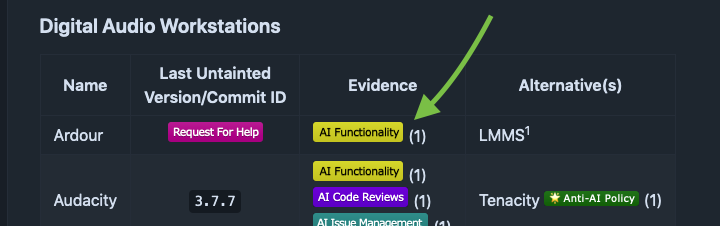
It should be noted that Ardour already is on various slop-lists (for example: ethical-foss/ai-free-foss-alternatives: Alternatives to FOSS projects choosing to use and/or support LLMs/AI, as well as tips for requesting better policies or forking. - Codeberg.org), so why stop there? Embrace the slop - embrace the fascism it supports.
2 Likes
@GMaq I’m not calling anyone anything. The only thing i want is to hear what people think, especialy from people that are, in this case, closer to nature&ecology than i am. The closest i get to nature is when i visit my country-side grandparents cottage/vacation home, and do some maintenance, and make some homebrew brandy with my mom, dad and brother  . The weight & seriousness of AI data center threats are known to me only thru media, and media kind of lost my trust long time ago.
Also, i used and i still use AI too - that is - when i must. What worries me is the feeling of inevitability in people’s attitudes - AI Or Die.
Well, i’m not so sure about that, aldo i get the temptation perfectly.
Also, if Ardour is inevitably going AI-assisted development route, i’d like to point out that chasing new features, in all seriousness, woudn’t be my main concern. I’d focus more on bug tracking and plugin compatibility and, not blazingly fast, but rather decent development tempo that @paul and @x42 can track and fully comprehend. 16 thousand lines that no one read&understood looks like 16 thousand potential problems to me.
@skygge i watched your FaderFrame YT video. Even if FaderFrame is that good as you are saying, that’s only possible because of it’s predecessors, and Ardour is clearly one of them. Plus, aldo i like&want some of the FaderFrame features (elastic time of course ) i know without looking that FaderFrame is buggy as hell. Anything complex and vibe-coded i tried was buggy. So…you know…chill a bit ?
Ardour is still a monumental coding effort and a great role-model for all floss audio world, so Ardour is still my way to go, AI assisted development or not.
1 Like
Yes, and I’ve complained to the people who put Ardour on those lists when we have a clear policy at this time of zero LLM-generated code. It is an outright lie to include the project at this time.
2 Likes
Of course, you’re right, but… every program has bugs. Over the years, I’ve reported quite a few on the Ardour bug tracker; some took years to get patched, while others were fixed quickly. I’ve been testing various DAWs- I won’t hide the fact that, due to certain shortcomings, I stopped using Ardour and had all but given up on ever returning to it. As for my enthusiasm: after a few days of intensive use, I haven’t encountered any glaring bugs - just a few workflow inconveniences. The most interesting part is that these were addressed and included in a new release… the very next day. Honestly, I’m not even sure what to make of that. I used Ardour for years, ever since the 2.0 beta, and I’d love to go back to it - but once you switch to other DAWs, you start to realize just how wide the gap between Ardour and modern software has become. I’m hopeful that “vibe coding” might make it possible to return to Ardour; it was the first DAW I ever worked with, and I have a great deal of affection for it. This text was automatically translated into English, so I’m not responsible for any errors it may contain
1 Like
This is much more a reflection of the fact that for most of Ardour’s developers over time, it has been more important that it function as a powerful tool for recording, editing and mixing human performances than for in-the-box composition. Most of the newer DAWs have a lot more focus on the latter; the old DAWs (protools etc.) have tried to bridge the gap, with various levels of success.
Nobody is ever going to use FL Studio to record a jazz ensemble or a performance of Simeon Ten Holt’s Canto Ostinato. That doesn’t make FL Studio a bad program, but it also doesn’t make Ardour a bad program for not being the best tool to do the sort of things people do with FL Studio (or Bitwig, or Live or …)
There’s a huge amount of stuff missing from “modern software” when it comes to some of the sorts of things Ardour has done for more than 2 decades. They don’t matter to most of the users of that “modern software”, which is fine. That doesn’t mean they don’t matter at all.
9 Likes
You’re both right here ( @paul & @skygge ).
I mean, i used a lot of different audio software on various platforms over the years, remember times of first pc versions of cubase&fruity (composition focused right away), hell, i even remeber messing around with trackers from amiga and 286 days. I can clearly remember when i first saw Reason 1.0, i tought Fruity is trash, a surpassed thing of the past .
Ardour was the first thing that did the job in Linux(i’m not sure when i first tried it…maybe 2006 or so), so i love it based on that fact. It’s like i’m very aware of what else is out there in audio production software world for a long time now, but i’m here and i do care about Ardour because it represents more free side of the digital audio world…and at the same time i admire it’s capabilities when you take into consideration it’s basicaly a two men operation.
That being said, i want it just to be stable as it can be, to play ball with plethora or linux audio plugins,and to be slighly more advanced in area where it’s lacking. That’s it.
Amen. I, for one, need drinkable water more that that.
Still, now at post #114, ~ 90 posts after my original one, the discussion is always always always going back to bugs, coding speed, new features, licensing subtleties.
There was a film about this feeling: “Don’t look up!”
3 Likes
Don’t be mad about it…it’s just that this is DAW’s forum, so people talk about the DAW. Intel was poisoning fields for quite a while, yet nobody ditched computers. It is what it is. But we all hear you, loud n’ clear.
Part of the point of opening up this discussion was precisely to engage with the question: given the obvious downsides of LLMs (at least as currently constructed and used in general) are there upsides, either for the world as a whole, or for Ardour in particular, that offset them?
People are going to have their own answer(s) to that question, just as they do with automobiles and planes and electrification, other widely deployed technologies that have substantial downsides and similarly substantial upsides.
So the question is not really that question but rather: what framework do we use to address that question?
1 Like
This, you mean?:
…which links to:
→ Commit d582a0b: Add MCP server control protocol
-___-
Oh no, not help for the visually-impaired…
AI bad. AI bad…
IMO, the first question should be:
Is whatever LLM we’re potentially going to use for Ardour directly tied to deforestation?
→ If yes, then don’t use it.
→ If no, then consider it a potential candidate.
I’d then opt to setup a 100% local, slower AI assistant.
You can then begin to reap some of the benefits of LLMs (etc.) without having the extra weight of Ardour forever being linked to this particular portion of accelerated decline of the biosphere for profit.
…
I’m actually quite curious about the feasibility and potential capabilities of such a local setup (-in 2026-2027), so I’ll look into this further and see if there’s any concrete links/tech. I can share…
The environmental problem is not so much using a LLM, but the training of the models. So using a local LLM won’t help with that aspect.
Also to efficiently run a model locally you need some GPU (more money to NVidia).
1 Like
If you do have a GPU, it is apparently easy to just launch a docker image with GitHub - mostlygeek/llama-swap: Reliable model swapping for any local OpenAI/Anthropic compatible server - llama.cpp, vllm, etc · GitHub .
I only have (20 core) CPU and hence limited to toy with https://ollama.com/ which is fine as talking rubber-duck, but really frustrating with GitHub - leocus/codeassistant.vim: A Vim plugin for a code assistant with local LLMs · GitHub.
1 Like