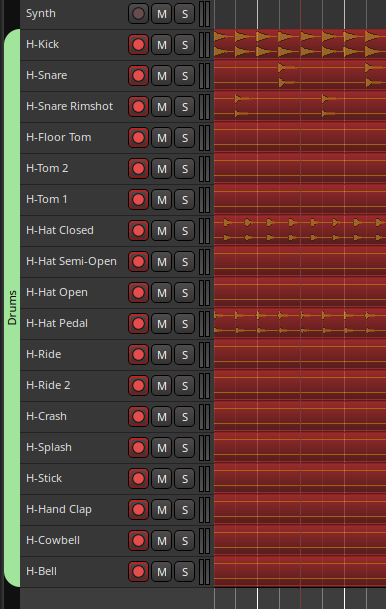
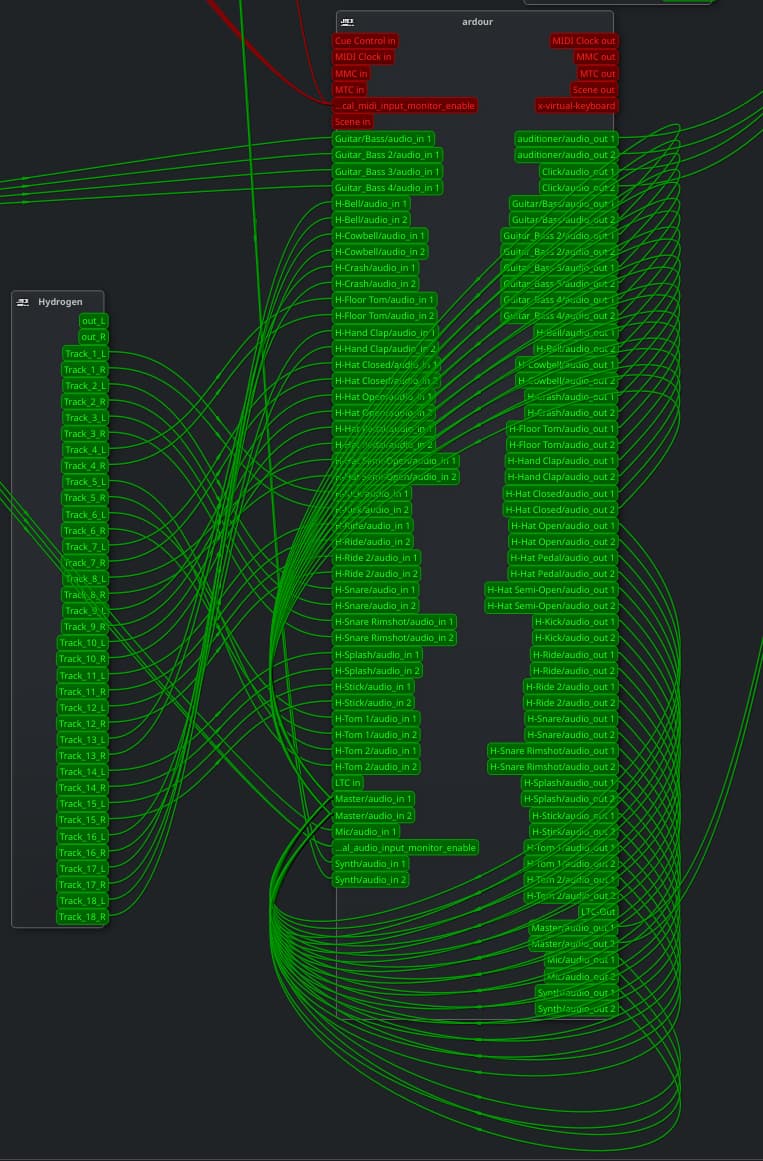
I use Hydrogen for drums because I like working in quantized time. I need to get Hydrogen’s output into Ardour, and I may at some point want to do something like throw a compressor on the kick, so I decided to route each instrument into its own channel. The channels are in a group, so it’s easy to set them all to record or mute or whatever at once. I can go into the mixer and put effects on individual channels as I like. Great so far.
But this takes up a ton of space in the UI in Ardour and qpwgraph. The routing from hydrogen to Ardour I suppose there’s no substantial improvement available. But maybe I can clean up all the Ardour sources running back into the Master sink somehow? Is this a good application for a Bus or VST? I don’t know what the conceptual differences are between those two and a Group, so don’t know which is most appropriate for this. I guess the cleanest thing would be a hierarchical setup, where all of these channels are Drums, then sort by Toms, Cymbals, etc.
Also, does an all-0 recording take up substantial drive space? If so I may need to do something about the many instruments I never use, like Cowbell, which will have tons of totally empty recordings eating up my drive.
Yes, if using the standard recording file format. Recording to FLAC would not, but that is not typically recommended for large multitrack projects, because it uses substantial CPU resources while recording if you have a lot of tracks.
Honestly, using FLAC doesn’t use much CPU resources on most modern machines. I believe it is even the default for Harrison LiveTrax as a result (Or at least I have been doing 48-64 track projects in it for a bit without issue).
Hey, yeah, this looks quite messy.
I think you could first think about how a real drum set is recorded (at least at a basic level).
do you need to have every kit piece recorded as stereo tracks ? not really.
do you need to have every little detail dumped into a separate track ? not really
things you don’t use: don’t record-arm these tracks and hide them away (or even delete them but I don’t know if hydrogen will complain about the loss of connections to ardour)
In general, for a basic recording of a drum set, you need a kick drum mic, a snare mic, 2 overhead mics for cymbals, and potentially a room mic. That’s it. Those are mono sources.
Of course, you can add a bottom snare mic, tom mics, hihat mic if you want to go into finer details but they won’t add much more to your track set.
With all these mono sources coming to your DAW as mono tracks, left/right pan as needed for stereo image. The main issue with real drum set recording is phase issues but in your case, since it is generated by samples, you don’t have to think too much about it.
So before outputting all of hydrogen’s kit pieces into separate stereo tracks, have this basic drum recording in mind. Then you can open the necessary tracks in ardour accordingly and link these kit pieces to their relevant tracks so as to emulate as much as possible a real drum recording session.
Common misunderstanding I see I would like to correct here.
Overhead mics are not cymbal mics. If you want a cymbal mic, put a cymbal mic out. Overhead mics are about gathering the entire sound of the drum kit. And if using a pair of overheads, they are often fact treated as stereo.
Sure. We do sometimes add specific cymbal mics, but for the sake of the OP’s request, I did not want to complicate things. I personally don’t do studio work but for our rehearsals, depending on what we are tracking, we may add these specifics mics or not. And yes, for the overheads (which we always use), we make sure to use matched pairs of mics. This said, the main point for the OP is to design a sane routing between Hydrogen and Ardour. One of the first things he could try is to group things better. I also don’t understand why all tracks are stereo when they needn’t be.