Hey rtp, thanks for your ideas, I was reading the loudness article on sourceforge the other day and it opened up my mind… so I´ll try next time mastering in six seconds (it´s I give up drinkin…) and tell you more… also listening on crappy systems is a good advice… although this for me is always necessary but also like to feel one´s way in the dark…: when it sounds bad on my kitchen radio… well , what to do? it´s quite time intense to work like this… but necessary, you´re right. lets see whats going to happen…
AND: I forgot the thx to thorgal
like I can see in the discussion here is that a lot of people are interested in mastering issues… and allenk: my question was not the recipe for a perfect mastering but just for some advices, so theres no need to be harsh to people that just tell their ways of doing things… every situation needs a different mastering, of course I ´d master a piece of morton feldman different than a piece of a crustpunk band , but I just wanted to heart some general things I had no clue of… and although I ´m not sure, I think people sometimes make a big miracle out of mastering and like its a good sounding word people and bands and producers talk more about mastering than recording/mixing, although this is much more important… one general question: I always thought for mastering you need that hardware that costs a fortune like mastering compressors and stuff… but thats a myth? Can I just use algorithms doing the job similar…? (i hope $$$)
rtp: yeah, go for it
until now you couldn’t do a batch job because you didn’t know, hehe. try my suggestion and see what an eye opener it is. i don’t claim it’s the final product. you can create more head room with EQ and multiband compression, but do what i say and see what a simple perspective is created. especially for those who don’t have experience.
give it a shot calimerox. i guess i’ve put myself in a position to write a new document titled Mastering in Six Seconds. i haven’t looked at Loudness in a long time. i knew if i opened my big mouth it would force myself into doing more work. i never learn.
calimerox, if you have something that needs to be mastered, put it onto a server and I’ll use it to demonstrate the six second master. they say it can’t be done. that’s all they have to say. I’ll post the .jam with two adjusted variables. and we’ll see if the algos work.
if you want to watch a video of an ardour produced album from the pre 1 stable days, try http://artspreservation.org/vidMix03-MPEG-4%20300Kbps.mp4 audio is jammin and ardour. unfortunately compression has made a mess of the quality
Think of mastering as baking a cake: assembling the ingredients equals recording, stirring it together and shoving it in the oven is mixing and putting the frosting on top is mastering. Sure the cake can be good in itself, but it’s the frosting that really makes it excellent.
To achieve top notch mastering you need great gear (which often equals expensive stuff), a really good room and an engineer with great expertise, knowledge and ears. An alogrithm can not beat that. Ever.
That said, in the end it’s up to the material. A crappy, uninterresting song mastered by Bernie Grundman will probably sell much less and sound much worse than a catchy tune with perfect melody and inspired perfomance mastered by you with a decent set of speakers and a basic knowledge of Jamin.
But then again, imagine what Bernie could’ve done with that song…
i’ve never shown this video to anyone but someone mentioned hammond and heck i’ve worked with those. i put together a five person audio and video crew for this production and never charged a penny. there’s not many of the old school boys left and i needed to do something for them. i love these guys. i’ve video footage of my make shift control room running ardour surrounded by gallon jugs of pickled pig’s feet.
that would be great! Now I work on a acustic guitar project… so its maybe not the most interesting thing to master, but anyway would be great to see what happen… I´ll talk to the artist and contact you afterwards…!
calimerox, may I also suggest you do a blind test with rtp405’s mastered file and your original with the volume knob raised to match his level.
That’s the purpose of that big round knob you see on your stereo, you know; to make a recording sound louder. And I bet there is a device like that on every listening equipment you’d come across.
Yes, louder often sounds better but you don’t need mastering to achieve that.
peder, thx for your advice, and yes, I know that big knobs. Actually I´m often asked to make something “louder” or “fat” or however you call it when it comes to mastering, and I get your point that louder is just louder, but loudness is not just louder. if you have a decent recording and master it so that it sound louder, you finally also have a better signal to noise when the consumer put it in his consumer mp3player or whatever it is(if you don´t limit too hard), it feels louder and the average volume is louder… I´m not in pro of having generally everything squared to 0dB, but often it´s an issue for semiprofessional studios that what you get out doesn´t sound loud, e.g. a rock band. and the idea of a rockband is to sound loud (maybe this is a major mistake of rock music, but thats another story…)… therefore for me loudness is a good thing to know.
On a recent (latest?) Metallica album, people playing Guitar Hero realised the version on there was way better than the cd. They had been mastered differently and I think even the band agreed the game version was better. The game version had much better dynamics; the cd version pushed loudness:
Guns 'n Roses latest effort is apparently mastered with decent dynamics, so it seems even the heavy rock boys are learning the mistake of ‘pretend loud’. Here’s what the engineer says about the experience: he offered three versions and the band chose the one which had dynamics preserved:
http://www.gatewaymastering.com/gateway_LoudnessWars.asp
And here’s a description of how dropping dynamics in favour of loudness is a bad idea:
master it so that it sound louder, you finally also have a better signal to noise when the consumer put it in his consumer mp3player
If buy that you mean a more even signal versus the listeners surrounding noise I agree. For my jogging mp3player I actually normalized the soft parts of Frost*s EIMA to be able to enjoy it, but the question is: who are we mastering for? Is it the jogger, the DJ at the loud party or the concentrated listener?
Perhaps all records should be released in two versions: a hifi version for the purists and a brickwalled version for the jogger/party DJ.
And if you want a rockband to sound loud dynamics and eq:ing are the way to go. When you have a dynamic span of 3 dB’s you don’t sound loud, you just sound even.
I’m glad Bob Ludwig and G’n’R went the dynamic way: http://www.gatewaymastering.com/gateway_LoudnessWars.asp
(Edit: hey, pleasebeus, you beat me to it
1 Like
And to be fair, regarding the latest Metallica the mastering engineer claims the levels were already hard brickwalled (as in visible square waves in any wave editor) when he got the stuff.
Listen to “Broken, Beat & Scarred” or “The Judas Kiss” to hear the terrible distortion.
peder, i got your point with the dynamic span, its not that I like it “even”, its more that usually I like dynamics too much, or when I listen back on it on my monitoringsystem, I enjoy full dynamics, but the “use” of music takes place in subways, streets, kitchens, TVs… and like usually you should listen and produce with similar conditions like the final consumer listens to, but thats difficult nowadays… we should maybe open a mastering contest but again, what is discussed here partly is a question of taste, but I was mostly interested in how people just do it and are happy with it for themselves, whatever they are working on… like for me the last good metallica album was kill 'em all… but this was definitley bad mastered… …
you must be taking the piss rtp… what about nasty spikes in particular frequencies… what about issues with mastering for vinyl… I wish it was as easy as you said…
( strange formatting appearing in Preview)
Just a line to tell you off my mastering changes.
I have to installed Ubuntu Studio 18* with Ardour 5.
After reading this thread I’m surprised that some off you don’t use Jamim, as I have always defaulted to this.
As Jamin has a tendency to quit without saving I thought I’d try look at mastering with Ardour.
Got to say I’m really surprised by the quality off the plugins.
I am now using :
Eq X42 Eq by Robin Gareus ( very very nice sounding EQ)
Dyson Comp By Steve Harris ( a musical Comp at last)
Tap Reverb by Tom sZilagyi ( very controllable Plate rev)
DR14 Dynamic Range meter ( giving me a DR off around 12)
These alone will give you 95% of any mastering you may need.
Many thanks to all the developers and Ardour teams.
Please note I play all my instruments apart from drums and don’t use Midi at the moment.
Cheers All.
Bob
2 Likes
There’s a general consensus in the archives of this forum that Jamin doesn’t sound very good, and can sound really bad on some compressor settings. It’s also said to use a lot of CPU power.
Now you say it tends to quit without saving and you’ve found some good plugins for mastering, and you wonder why people don’t use Jamin!
I have the LinuxDSP multiband compresssor, which unfortunately no longer seems to be available since they became OvertoneDSP. Not that I use that much for mastering - I’m aiming for natural sounding recordings of acoustic instruments and voices and use very little processing for mastering. But a good quality EQ, compressor and limiter will get you a long way.
I use Tracktion’s Master Mix (https://www.tracktion.com/products/master-mix) multiband compressor (and EQ) for mastering, it is not free but also not too expensive when on sale. And it offers lots of flexibility to perform subtle correction and fine tuning.
Reviving this old topic rather than creating a new one. I’ve switched to doing my mastering tasks in Ardour in the last year or so and have settled on the following setup which works quite nicely I think.
x42-eq → ZaMultiComp → ACE Compressor → ZaMaxim
Nothing is working particularly hard but the combined effect seems to glue things together nicely 
Wondering if folks out there are doing things differently or have thoughts about the sound of other similar plugins to these, things like that. There are multiple choices for each of those stages as free software before you even get to commercial offerings, which I’ve not investigated at all yet.
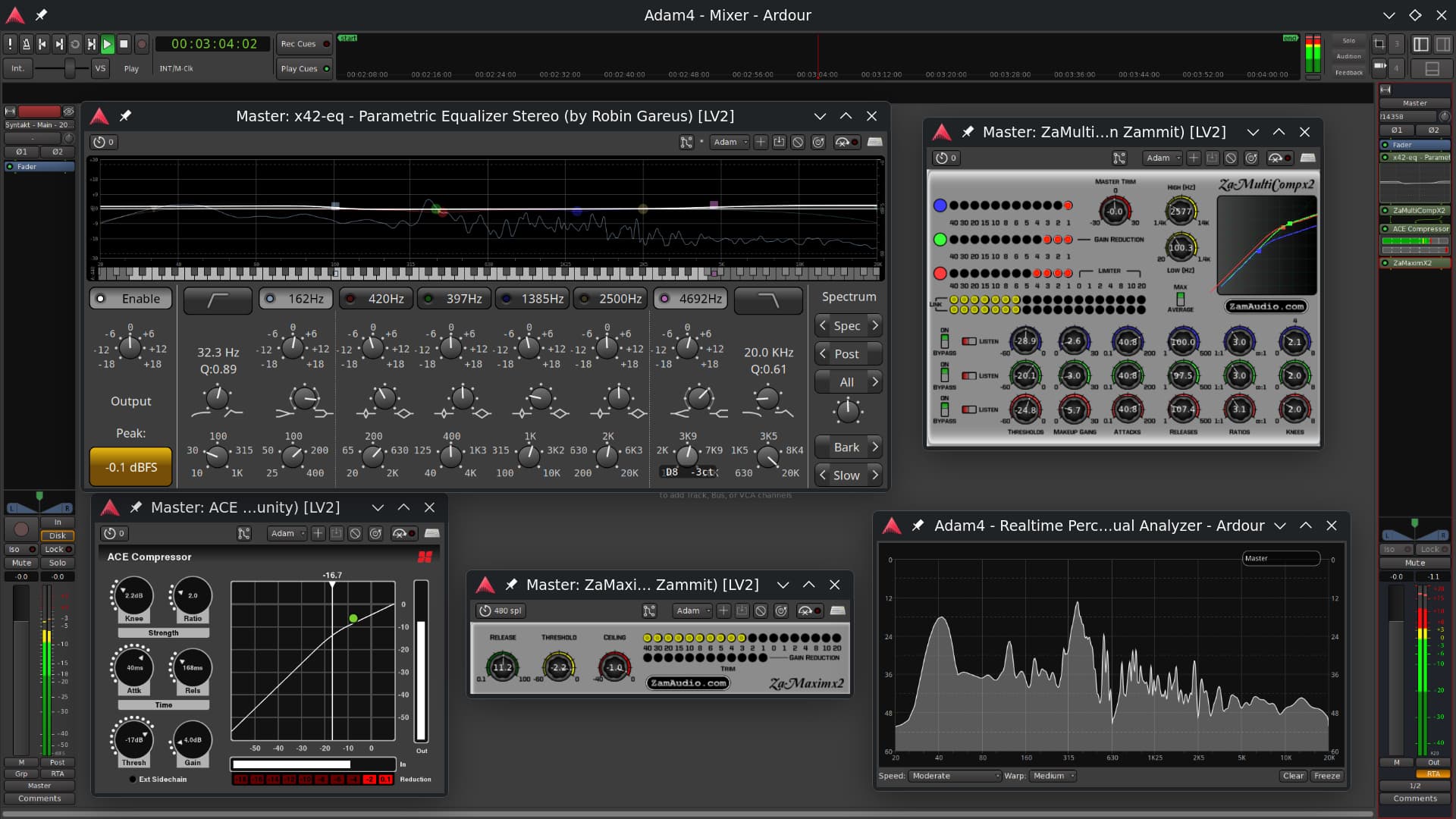
PS: It all works perfectly in the new RC for 9.0!
6 Likes
This topic was automatically closed 60 days after the last reply. New replies are no longer allowed.