Okay, that’s interesting. When I looked at the Scarlett range a couple of years ago they didn’t work properly under Linux.
You might find this interesting:
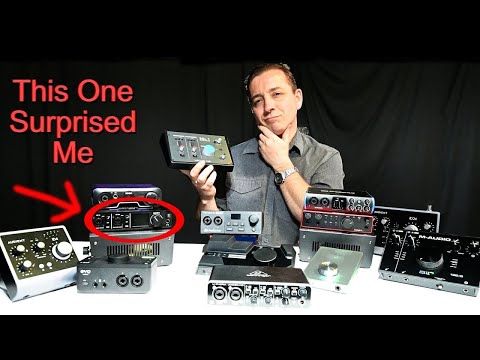
Most of these will work on Linux (if not all) although, where there are proprietary control apps (like the Lewitt Connect) those apps mostly won’t work.
Cheers,
Keith
4 Likes
I think you are probably referring to the internal routing and mixing capability. The Solo was always an exception because it did not have that, just the front panel controls, but someone created an open source app a few years ago for the higher channel count devices:
3 Likes
@geoffreybennett has also done a ton of work (with hardware support from Focusrite) to expedite support for their new interface models in mainstream kernels.
3 Likes
I concur with the previous comments on Focusrite. I recently got an 18i20 4th gen for our rehearsal room / studio and with Geoffrey Bennett’s outstanding work, everything and more works. Focusrite was even made aware of his work (after G.B started a funraiser) and started to support his effort by donating h/w and information to him. The h/w will even become an 26i28 with the newer firmware, which G.B. is currently working on. Really nice looking / sounding and versatile piece of h/w which is fully supported in linux (I use debian trixie with a 6.14 kernel, minimum kernel version for G.B’s linux-FCP framework). The only thing that could need some rework is the alsa-scarlett-gui (all functionality is available via the GUI but the GUI itself gets a little unwieldy the more IO the h/w has).
3 Likes
Also recommendable: The single channel Zoom U-22 which works out of the box on Debian 11 here and is dead silent when idle. Obviously relatively high-quality preamps. They build comparable multi-channel DIs, too, certainly worth looking into.
All guitars in the song below have been recorded through a VOX AC30S1 and an AC15C1 into a Zoom U-22, the bass directly into the latter and EQ in the DAW:
Hope this helps.
Cheerie-o!
1 Like
I use older (>13 years old) Presonus hardware that no longer works on Windows (and I assume neither on Mac) like the 8-channel 1U rackunit 1818VSL. I don’t know what quality you are looking for, but it’s a pretty decent unit and unlike under Windows it’s supported under Linux/Ardour (though not all functions!). There are/were pitfalls: Intel made a buggy USB chipset that made it produce cracking and pops. As it turns out, that was not Presonus fault but intel’s. If you can avoid those chipsets for example by using an AMD based machine you’ll have no trouble. (For more info I wrote a post on this forum about it). If you can find a cheap one second hand that might be a good fit for you.
1 Like
Basically Firefaces and Babyfaces work but you don’t have TotalMix on Linux which sucks. Older Hammerfall DSPs had hdspmixer as a replacement but that doesn’t AFAIK work with newer cards. You can do some stuff with jack (forgive me mentioning the evil audio server) or with the “good” audio server -Loonixplumber or Pipemaster or what’s its’ name - that never seems to works for me, like connecting inputs and outputs but it’s just not the same. Also, no plugins (dynamics, eq) directly on the HW - unless, of course you set them as a preset from TotalMix and run a Fireface UCX standalone. Which won’t let you record from Linux.
1 Like
Probably all of them, except for the Fireface UC USB! This first device in the Fireface series isn’t class-compatible and never will be.
But it’s still an excellent device.
Gladly:-)
1 Like
I have a Clarett+ 2Pre and can only second the excellent work @geoffreybennett has done to support that on Linux. The device has pretty good latency (I measured about 1.7 ms on-device latency a few days ago, using jack_iodelay). The app Geoffrey develops also exposes features that are not possible using the official software – turns out these things have a full-fledged mixer built in as well.
1 Like
That’s right. I really enjoy the flexibility of the internal routing and mixing (resembles what I was doing with the hdspmixer on the Multiface II back then). But since I got the 18i20, I tell you, the mixer window is huge and gives me brain-pain every time I have to change something. Fortunately, one can save and load configs so I made sure to have the saved card state every time I knew I would recall that state eventually (we share the 18i20 with other bands and I always find the card state completely messed up when I have to use it  ).
).
1 Like
Another big RME fan here: very fond of the Babyface Pro FS in CC mode. If I ever need to replace or upgrade it, I’ll stick with RME.
There’s a third-party mixing/routing app for the Babyface here that works pretty nicely. Personally, I switched distributions, got lazy, did the signal-routing in JACK while I summoned up the energy to recompile it, and… never got around to it. The latency is pretty darn good, these days, and all I want from an audio interface is ADC/DAC anyway.
RME put a video on Youtube a while ago, explaining why they weren’t moving on from USB2 any time soon: the short version is that it’s already fast enough.
If you want more I/O without patching in external converters via ADAT, the UCX-II is worth a look. Or you can patch in (and under-utilise) a Ferrofish Pulse 16, which I can attest is also very neutral.
Focusrite are also popular, and much cheaper, but their preamps colour the sound - some like it, but I’m not among them.
So that’s worth bearing in mind as well: if you’d prefer neutral (and very clean) converters, and to add tonal colouring via your own choice of mic preamps, RME is a good way to go.
3 Likes
We’ve tried a BabyFace, delivered today. Works really well to remove the hiss, so that’s a win, but now we can clearly hear something really dirty over the power somewhere (specifically through the Roland Fantom synth… even when it’s powered off). Some kind of ground loop or similar but so far I’m damned if I can find where it’s picking up the noise. A subject for a different thread though.
1 Like
I hate ground loop trouble shooting lol. been there. Years ago, I tore up my studio looking for ground loop to find out it was a card in the computer… Fun days.
Sometimes on old amps patching the send and return help with the dodgier electronics. maybe the roland has a send and return?
I have heard good things on both RME and focusrite clarett+ in linux.
2 Likes
Late to the topic. Lot’s of nice recommendations for a replacement hardware, but no real troubleshooting advice.
High pitched whine in USB devices is, from my experience, often an electricity issue. I encountered them with USB connected synthesizers, audio interfaces or other peripherals.
To be honest, I have no clue why I was able to solve those situations. But the “how” was always the same process: tear everything apart, and plug back together in systematically varying combinations (some system, just so that you do not run in circles and try the same stuff again and again.)
Now you have a ground loop. Often the same process applies as with the whine.
My most important lesson was to have all gear hanging on a single wall socket. Make sure to plugs with surge protection and under current indicator. It helps having confidence. Then pray that your houses breakers can cope when the power is switched on. Not an electrician. As I said, no clou about the why, just sharing experience. Maybe someone can elaborate.
If your breakers blow, chain the power connectors in a way that allows powering in stages, sometimes that helps, as the spikes are not as high or something.
Edit: some power supply connectors are just loud. You can isolate them with your ears and replace them. Some have high pitched whine, some the god old 50hz hum. Again, from my experience, replacing those audible devices solved issues.
Another aspect is cable layout. Avoid coiling up long cables. Always try to keep all cables straight as much as possible.
Also try to separate Audio and power cables.
1 Like
Found it. The actual PC, bought fanless for physical quiet, generates a ton of electrical noise when “doing stuff” (it’s weird, not just video or disk or whatever, just activity in general) and passes it back to ground via the PSU. We’d never noticed it before because all the previous synths had a C7 power connector to an external power brick so were inherently detached from ground.
Currently it’s fixed by disconnecting the ground pin on the power cord, but that’s somewhat inadvisable in the long term…
3 Likes
The original post did not ask for troubleshooting advice, it asked for advice on a new audio interface.
Implicit in that seems to be that you have a new synth which has a 3-pin power cord.
Does the synth have balanced outputs, or only unbalanced outputs? If only unbalanced you may have to use a transformer isolation box to avoid noise currents flowing in the signal return.
2 Likes
Yep, thee pin kettle lead direct to the body (it’s a Roland Fantom-8). Both the XLR and TRS outputs show the same problem.
1 Like
Good to know. Had issues with a Fantom back in the days as well. Sold it though.
INCREDIBLY inadvisable. Really.
Get an audio isolation transformer on the audio line. If the connections are balanced lift the audio ground (Lift the shield) as an alternative if you must (Isolation transformer still preferred).
NEVER LIFT AN AC GROUND!
My students do not want to be on the receiving end of me when I see people do things like this. Neither do the professionals I see do it on occasion I am in charge of.
Seablade
7 Likes