@flyx
I have created 3 sample files from your MIDI file, all rendered in slightly different ways:
Please tell me which of these you feel to have “unnatural” pitches.
Cheers,
Keith
@flyx
I have created 3 sample files from your MIDI file, all rendered in slightly different ways:
Please tell me which of these you feel to have “unnatural” pitches.
Cheers,
Keith
They all sound the same to me, but different from the MuseScore or Ardour one, I think it’s timbre, changing the instrument to a piano, changes it too, I need higher quality instruments then or timbre changing instruments. Reverb also does it but very slightly and only the MuseScore Reverb.
And a slight PSA, don’t put unnatural in quotation marks, I speak very vaguely, because I am autistic I use certain words more, my writing is different, it’s all an autistic struggle, don’t take this as an insult, I mean more like different in a bad way. Respect Autistic people more, don’t take this as an insult. It made me fail a duolingo lesson one time, when I confused girl, daughter, female and woman.
High-functioning autistic people tend to perceive subtleties better than
the general population. Have you listened to a piece that you like,
explicitly tuned according to different schemes?
I found this to be my favourite from a 2017 game:

I think, my favourite scale is A Major, it feels like in this, it goes a bit higher and then lower to the bottom in A Major, but I don’t think this answers your question, but I still notice subtle differences like the carpet being a bit off, and my mom mocking me over it, I can notice that chrome has changed very slightly over the years, it still has that rounded look, but the colours have changed a bit, I caused a bit of drama on an another forum, after GNOME removed one of the default wallpapers but I use my own now, so I can notice very little details, I also have extreme emotions like if you change the mug to a different one, I will nuke you. In my country, autism is seen as a dangerous terrorist contagious disease, lol. But most autistic people I have found online aren’t as extreme as me, so I think I have an extreme case of it, and they caused a bit of drama on it, I can talk all day on this.
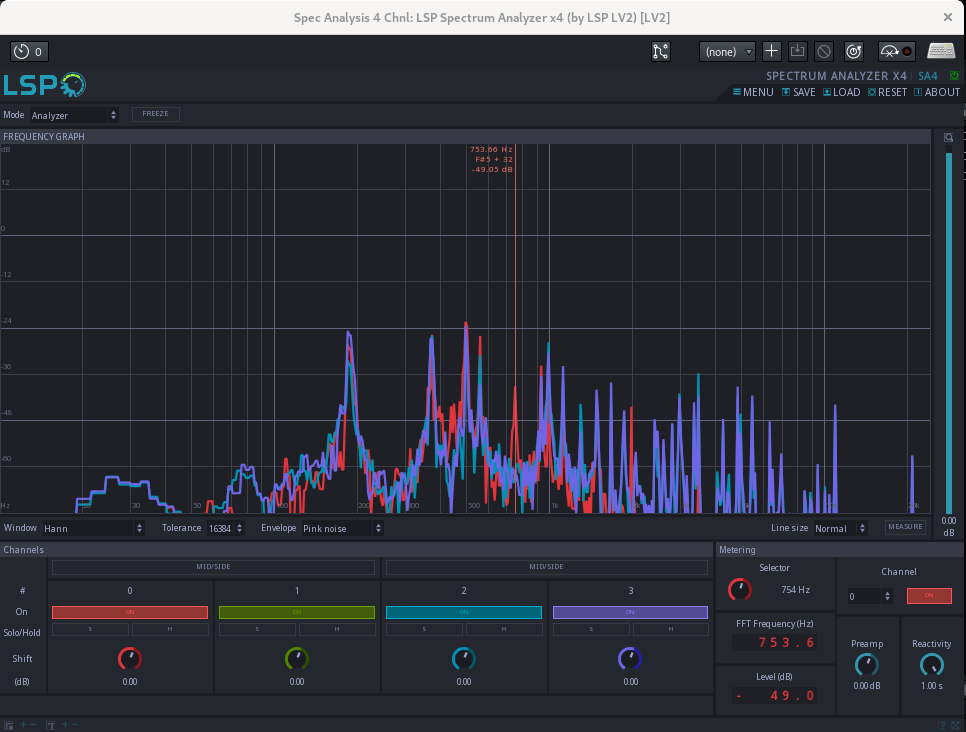
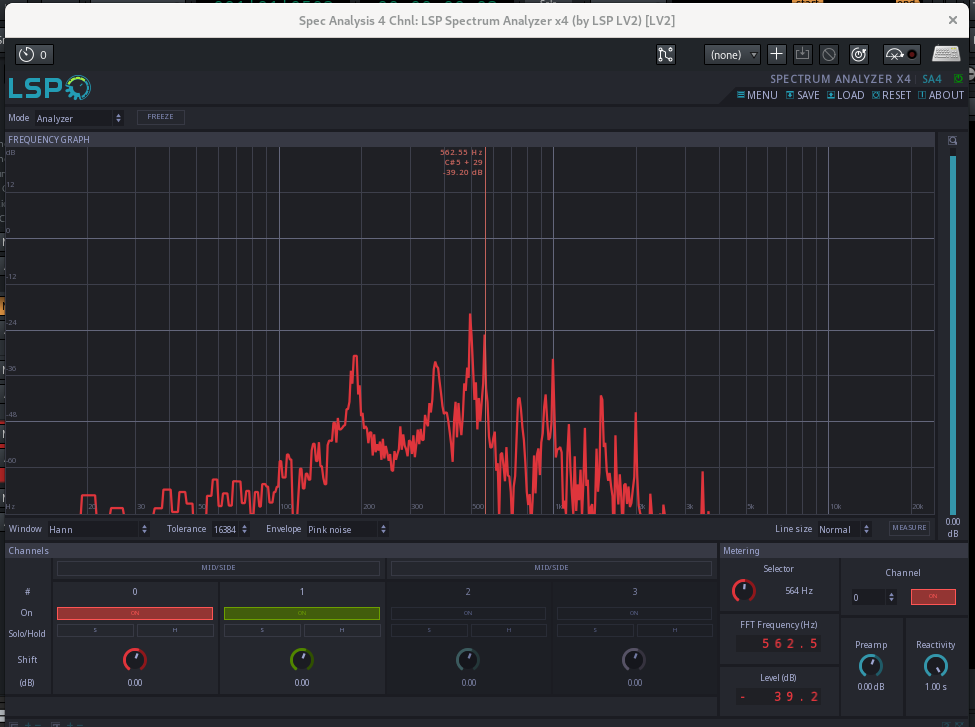
I took the files provided by @flyx, imported them into Ardour, and ran them through a LSP Spectral Analyzer on ONLY very first note/chord of the samples. What I found is the the pitches were correct as well, but the Odin.wav added several more overtones, which seemed to include notes that were NOT in the first notes (F#3 and B4), and was also MISSING the F#5 which was very prominent in the MuseScore version!
Several Notes created in the overtones from Odin.wav were D7, C8,F8, G8, and F9, and others.
For reference, the notes of the A Major scale are A, B, C#, D, E, F#, and G#. C, F, and G do not belong but show up with Odin.
Also, with ElecPiano.wav, there is a C#5 being produced that is louder in ElecPiano.wav, but present within both instrument wav files… Maybe @seablade has an explanation ? I don’t know. I don’t use a spectrum analyzer that often.
RED /GREEN is Musescore provided by flyx
PURPLE / TEAL is Oden provided by flyx
Interesting.
Exactly.
All of the samples I posted were based on the same instrument, but using different audio tools. I tried to use an instrument that was close to the one you used in your MuseScore recording (which, by the way, was called “Tine piano”).
So, whilst slightly different from your original MuseScore recording, you are happy that none of these samples have unnatural pitches?
I am hoping that you able to see that, when playing the same MIDI track, through the same MIDI instrument, with the same settings, but using different pieces of software, if one of those piece of software was was affecting the pitch or the timbre, then that would show up by the sound being produced by that application being audibly different from the others?
I have avoided putting quote marks above not because you are austistic, but because you have indicated that this triggers you.
Please don’t consider it an insult or an attack on your when I point out that the majority of autistic people do NOT have this particular trigger, so expecting me to know this of you is not reasonable.
I would also ask that you don’t disrespect others by assuming they know nothing about autism. The sort of respect you are demanding goes both ways.
I should point out that I am very familiar with autism having raised a child who was autistic, who we are still having to provide a great deal of support to now she is an adult. My wife has also been a teacher in special needs for the last ten years during which she worked with hundreds of autistic kids up to the age of 21.
I will point out that we are trying to help you understand how this works and why your original claims that Ardour was introducing unnatural pitches in the MIDI track were completely incorrect, and some of us have spent a considerable effort into creating evidence to back that position up.
If you aren’t going to be receptive to understanding that evidence for whatever reason (and the reason is irrelevant) then there’s a good chance people will thin twice about helping you.
Cheers,
Keith
This is normal, and exists for acoustic instruments as well. Overtones are how we differentiate the sound between instruments, the ratio of those overtones, and amount/energy in the overtones creates unique sounds even if the fundamental frequency (Which generally translates to pitch) is the same. This is why a flute and an oboe sound different, and what makes Odin sound different from Muse’s synth.
Seablade
By the way, at least one of these samples was produced using Ardour. If you cannot tell which, then it cannot be Ardour which is causing the changes you previously reported.
Cheers,
Keith
Is there anyway to add those overtones manually through a plugin?
I know this was directed at @Seablade but I will provide an answer:
Yes!
In fact, that is exactly what you are doing when you created this track on Ardour: you used a plugin which created these overtones.
In this case the plug was Odin2.
The overtones are created by the plugin in various ways. The first way is the fundamental waveform that’s used to generate the sound:
Then you can use another oscillator (or more than one) to modulate the original waveform to produce all sorts of overtones (and accompanying weird and wonderful sounds). There are different modulation methods including frequency and ring modulation which are commonly used in synthesis plugins like Odin2 to create such overtones.
The point is, these overtones are produced by the plugin, Odin2, NOT by Ardour itself.
Cheers,
Keith
As @Majik mentioned, these do have to be created by the plugin, Ardour will not create sounds by itself beyond things like that metronome.
HOW to create them depends on the plugin in question, @Majik described ways to create it utilizing different types of wave generators, but essentially what you are discussing is synthesis, aka how synthesizers work. There are two more common ways in which they work, either additive synthesis or subtractive synthesis. Additive synthesis typically starts with the fundamental and adds overtones, which there are often mathematical relationships for. Subtractive synthesis kind of works in reverse, starting with a noise and removing unwanted aspects of the sound to create the desired sound.
At this point I should note, I AM NOT A SYNTHESIS EXPERT. I understand the basics, but don’t go much beyond that. I trust others to create the synths, I will jump into some basics when I need to, but in general I don’t feel that is work I should be doing on a regular basis.
At any rate, what you seem to be looking for is additive synthesis, and it depends on the plugin how much control you have on this. I couldn’t tell you what capabilities Odin or other synths have, other than to open them up and play with them until I find them.
Seablade
As a Guitar builder/repair man for over 40 years, I have seen it all in that regard! Sure some people have hearing problems and hear ghost notes at certain frequencies, but man is there a lot of people who’s hearing is based on their beliefs, and those beliefs based on being influenced by others! I was an electrical engineer/physics geek before I ever started repairing guitars some 4 decades ago, and it lead to learning a lot about psychology because of it! Both conformation bias and the placebo effect are very strong forces!
Ethan Winer is a very smart, wise and overall great guy!
Well, to reveal and, hopefully, to put this to bed:
A - Played in MuseScore but with the MIDI output connected to a MIDI track in Ardour, using Ace Fluidsynth instrument plugin. So MuseScore was playing the track, but it was rendered within Ardour
B - MIDI track imported into Ardour and played using Ace Fluidsynth instrument plugin. So the track was played and rendered within Ardour.
C - MIDI track imported into MuseScore and played using soundfont instrument. So the track was played and rendered within MuseScore.
In every case, I used the same soundfont and instrument. Specifically, I used the E. Piano 1 setting from the classic 8MBGMSFX.SF2 soundfont.
I originally tried to import the MuseScore sf3 into Ace Fluidsynth so I could use the exact “Tine Piano” instrument that the OPs file used, but I couldn’t get it working for some reason, so I used a soundfont I knew would work, which sounded very similar, and which I could use both within Ardour and MuseScore.
I also normalised each track to the same level (-6dB).
The result is three identical sounding tracks demonstrating beyond doubt that Ardour does NOT inherently have any impact on the pitch, tuning, timbre or any other character of the sound.
Which should be no surprise as exactly the same instrument plugin was used in every case, as it’s the instrument plugin that creates the sound.
Of course, if you do want to change the character of the sound within Ardour, you can by using plugins to shape the sound as you want, including using different instruments.
But even then, as @Seablade points out, that’s a function of the plugins, not of Ardour itself.
So the shocking conclusion of this whole thread seems to be: different instruments sound different from each other. 
Cheers,
Keith
The first times “the boy cried wolf” in the story, there was quite a hubbub in the “community” 
I think what’s causing the problem is because it’s a midi file imported from other DAW, some DAW’s utilize somekind of different language and configuration to store midi information, I had that problem with a midi file made in StudioOne, I imported to Cubase and the velocities and pitch bend information where different.
No. It’s literally because the OP was using a radically different instrument in each application (and was playing the track at a much faster tempo in Ardour).
All the note velocities were constant and there were no pitch bends.
When the same instrument was loaded in both apps, and the tempo was kept the same, they sounded identical.
Cheers,
Keith
That’s what I’m trying to say, some DAW’s interprets midi in its own way, some programs are coded different. That’s why is not good idea to be changing of DAW because you can loose some project information, even audio information could change between different DAW’s.
It’s advisable if you going to make a project in Ardour, try to finish it in it, if in Tracktion try it too, if in Bitwig too, or export stems as .WAV 32bit Float to work in another program.
I’m sceptical of that claim.
As I said, in the OP’s case it was absolutely nothing to do with the DAW. It was entirely the choice of instrument plugin.
And I think that is the case 99.99% of the time. MIDI is MIDI and DAWs, like Ardour, generally don’t do anything with the MIDI data except store it and replay it.
Play a MIDI file through 10 different DAWs and it will sound the same as long as you use the same instrument plugin and the settings are the same.
(And you haven’t applied other effects mixing, automation, etc.)
Pitch-bends, velocity, and all.
(There are exceptions, like Mixbus which can sound different, not because it treats MIDI any differently, but because of the special audio processing it does to make it more analogue sounding).
In the OPs case, the other tool wasn’t even a DAW, and yet it sounded identical.
Cheers,
Keith
Please read this article, specially the Concern #3: But I’ve heard OMF and AAF are really terrible. part.
And then explain how any of that article (an article that, by the way, was making the case for why it’s perfectly possible and, often useful to use more than one DAW) in any way supports the following, probably entirely erroneous, claim:
I’ll be waiting…
Cheers,
Keith
EDIT: Clarified the quote in the post – Seablade