A good song mixed badly is better than a bad song mixed perfectly 
1 Like
I would like to point out that there are two things here:
-
Publishing music at high sample rates (>48kHz)
-
Recording and mixing at 96kHz, to reduce latency and to avoid the potential artefacts that some plugins introduce
The first of these is covered by Monty’s Xiph video. The second is not.
Recording and mixing at 96kHz and then downsampling to 44.1kHz or 48kHz to publish seems, to me, to be entirely valid.
Cheers,
Keith
1 Like
Totally agree. It’s about the music, not the hardware.
Disk space is cheap. I have terabytes of space to work with, and can always expand if needed.
I dunno. I started this thread wanting to get to the higher sampling speeds and ended up finding out my system was horribly configured. Fixing that was the best result from this. We’ll see if the jump is worth it going forward.
Have you tried buying any storage recently?
4 Likes
Actually, yeah, I added 4 TB in the last year or so, well, maybe 3.5TB as I replaced a 500GB drive. Added a 2TB SSD and a 2TB spin drive for backups. Got about 6TB on my system overall, and one or two other drives are probably due for replacement. Spin drives are fairly cheap and probably won’t go up in price very much. AI doesn’t want spin drives; it want’s memory and that is the main driver for the shortages and price increases now. Overall my storage requirements are fairly low.
And really, a spin drive is fine for an Ardour project. The system will buffer your project in system memory anyway and you’ll only see a slight slowdown when you save the file, though I suppose it would depend on the size of the project and how many channels you’re doing. I would still keep it on the SSDs though and just archive projects to a spin drive.
Cheap is a relative term though. It’s fairly cheap to me, though it’s never that much fun to replace a drive.
Blockquote
AI doesn’t want spin drives
Hmm, I’m not so sure. They’ve basically doubled in price in the last year, though it seems to have leveled off at the moment. AI wants everything, and there is a knock on effect to anything that uses semiconductor parts, which includes the cache memory and CPU etc in a spinning drive. Obviously as a plug-in developer I have limitless funds but I still wouldn’t want to buy at the moment.
(but it would rapidly get expensive to equip even a modest home (studio) NAS / RAID, compared to say a year or 18 months ago and if you don’t have a good backup solution, then your data as good as doesn’t really exist)
2 Likes
You misunderstood the discussion. The artifacts have nothing to do with hardware, if the software generates a sequence of digital values which do not represent a validly low-passed signal you get alias products generated completely in the digital domain. That is possible with non-linear processing such as limiting and distortion effects.
As previously discussed some plugins up sample, perform the non-linear processing, and down sample after. Since both upsample and down sample operations require low pass filters it can add some additional latency.
And apparently some plugins do not do that, as the Mixbus drive effect was reported to generate “clearly audible” artifacts.
Well, they may have shot up again since I bought a few months ago. It’s just that they are going to use far more DDR memory than they will HDs. They just need HDs for storage, which has higher density per dollar and data can be compressed there, so they’ll need less of those. They still need them though, and yeah, prices tend to go up across the board when people start hording stuff since, like you say, they’re still taking resources that are used across the board.
In fairness, I brought up the hardware and in particular the analog low pass filters used on the input side and he was probably referring to me. I mentioned cheaper interfaces might use cheaper designs here to save a few bucks, which could lead to aliasing. It’s not so much audio I was referring to though. Noise exists across the whole spectrum, so a cheap filter may allow noise to alias down into the audible range at lower sampling rates.
I’ve been debating myself about that though and if I’m just being that old “back in my day” geezer. It was certainly an issue the last time I built an analog filter some 30 years ago. There’s probably off the shelf chips now though that give those near perfect curves making it unlikely in any commercial audio interface, cept maybe some onboard audio solutions.
Possibly off topic, but FWIW, for the kind of material I record, a 96k FLAC is typically about 70% of the size of a 48k WAV, and 35% larger than a 48k FLAC. This is for identical audio content, using the default compression settings. Seems like an OK “compromise” to me. But using WAVs for 48k sessions? You may well be wasting disk space for no discernible gain…
Note that all FLAC files are quantized integer formats (not floating point).
So when recording, preferably use 24bit FLACs; otherwise you have to be a bit more careful setting input gain when recording (as deliverable 16bits are perfectly fine though).
1 Like
In posting to this thread I was just trying to help out someone who reported experiencing issues running a 96k session; something which I had also experienced … but, … for anyone struggling to understand why anyone would want to resort something so obviously ridiculous and pointless as a 96k session rate, or why plugin designers waste processing power with latency-inducing up-sampling for any non-linear processing within plugins, the following ADC talk by plugin designer Sam Fischmann might be enlightening:
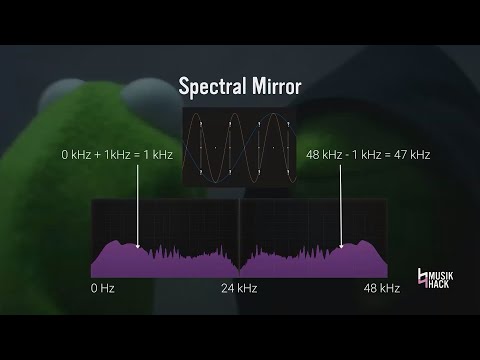
There’s an example of what aliasing sounds like about 5 minutes in, and an explanation of how aliasing can arise with ITB processing about 15 minutes in. Then he goes on to explain how oversampling helps. The talk also mentions issues with latency, computational cost, phase, Gibbs effect, filter design, etc. for oversampling.
During the talk, around 37 minutes in, he observes that it’s often simpler to do all processing in an over-sampled context, and that it’s computationally cheaper to filter between non-linear stages rather than down and up sample (and, I would add, lower latency if you use an IIR filter). At 40’25" he talks about how we might want to run the entire project at a higher sample rate, especially if we want low latency, and that it would actually be a much better solution, provided you remember to have LPFs between non-linear plugins to avoid the aliasing staircase. He proposes this as a general solution for DAWs/channel strip plugins (41’29").
I guess that if a professional plugin designer says higher session rates are the better solution, it might be worth some consideration. I’ve done the latency & load measurements, file-size checks, and listening tests; for me with my use cases on my hardware with my plugins, 96k sessions are often the better solution. But, what do I know? I’m just some guy.
That’s all from me. 73.
2 Likes