I’m not too familiar with AI stem separation outside of using demucs [specifically, v4 ft (fine tuned)], and many other models on Ultimate Vocal Remover v5.6. Personally, I’d benefit as a user if it were implemented somehow in Ardour, but I assume finding the right smith set of process methods and their relevant models would be tricky. And then UVR has advanced menus for each processing method and more. I wonder how an implementation in Ardour would appear…
While I also assume that almost always it’s used for remixing/sampling, so far I’ve personally used it for the purposes of
Trying to get a clearer copy of the vocals to recognize the words of a song(if I can’t find the lyrics),
Learning some drumming patterns
Trying to hear out and recognize chord patterns (or note patterns/intervals, if the sequence is faster than what I can understand without the efforts of separating the stem(s))
[For the latter point, I’ve also used NeuralNote sometimes on the separated stem, to try and help myself recognize some patterns, though I’m not fully accustomed to a MIDI pianoroll.]
Yea, “phasey artifacts” i kinda knew it…that’s exactly what i was afraid of. I was on the edge to purchase RipX just to save my first work from the oblivion (funny i made an entire album back then, and i wasn’t even aware that’s called “music production” ) , but when i tought about it, my dilemmas just multiplied for various reasons. Phasey afrifacts is something i definitely don’t want to introduce.
Lately i’m thinking of doing a proper “Redux” from scratch, but i freeze when i think about how much actual work is in it (midi programming, different instrument layering, envelope shapping etc) , cause, you know, it’s not a “Master Of Puppets” or something, it’s just a self-made album by a boy influnced by Moby, Enigma, Prodigy and d n’ b.
And i was stupid enough to keep the projects on floppys. Some i can’t even find, some contain something entirely else now, and some are just unreadable. All that is left safe is, by some miracle, still functional CD. How dumb can a young man be?
Interesting. I’ve used some of the on-line services, but this the first I’ve heard of Spleeter and Demucs. I took a look at Spleeter - definitely worth a try.
@x42 mentioned the complexity of python, but if you’re running the models locally, you’ve also got GPU libraries that might need to be installed. On the other hand, if you’re using models in the cloud, you might not need anything more than some kind of REST client.
I agree with @Locynaeh that a standalone app seems relevant, especially given the complexity of running on a local GPU.
Surely we don’t want Ardour to be dependent on something like TensorFlow, do will? I think that’s what it would be with Spleeter, basically.
Of course, TensorFlow integration would probably give Ardour the capability of running some of its effects processing on a GPU, which might be useful. Still…
There’s a lot of AI models available. Which stem splitter to use should probably be up to the user; like picking samples or plugins.
What would the GUI look like? You select a region and click on an option to run it through a stem splitter?
This project is Python Based, and has an alarming amount of signs pointing to it being vibe-coded. It mentions multiple appimages yet only 1 exists, only has one commit for all of the code, the code of conduct being, word for word “This project adheres to a code of conduct. By participating, you are expected to uphold this code. Please report unacceptable behavior to the project maintainer,” the readme doesn’t make any sense in some areas, and not only will the appimage not run on my machine, the build instructions and build scripts don’t work and sometimes point to files that don’t exist.
A.I. Stem seperation is a good use of the tech, but this just looks like vibe-coded nonsense.
If the project wasn’t “vibe coded”, would that make it not working for you feel any better? You haven’t reported any bugs on the github. It works fine for me, so this is an issue for you rather than the program per se.
AFAIK this is the only open source GUI on Linux available for using Stem Separation technology so far. If there is a problem other than it not personally working for you, do say but just deriding something as “vibe coded nonsense” is not helpful to anyone.
If it wasn’t vibe coded, I would’ve in fact reported the issue’s I’ve seen to the issue tracker, like referencing links and files that don’t exist. But I suppose I’ll take the time to make the issues on the project.
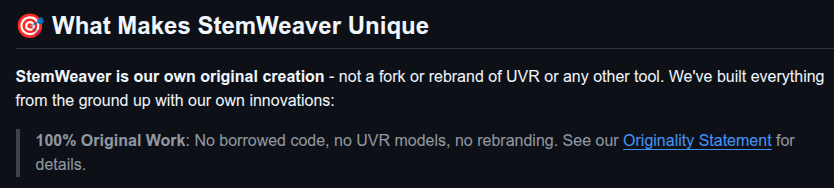
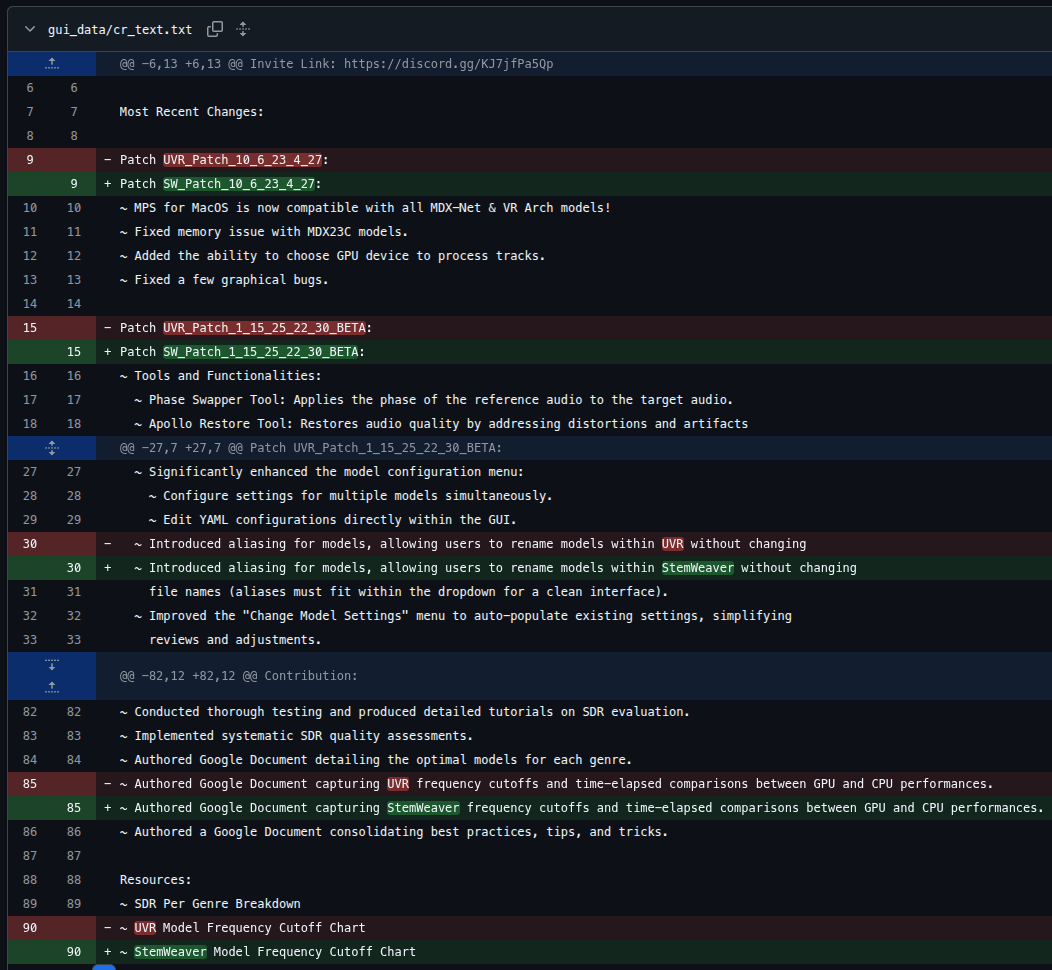
Aside from the fact that the “Originality Statement” link is 404, the fact that it’s so adamant about not being derived from UVR (aka ultimatevocalremover) is interesting when you look at some of the change history like this:
I think most of us around here appreciate open source. Personally, I’ve found 3D prints of open designs I’ve published on Thingiverse for sale on e-bay. I find that obnoxious. Don’t think I’ll be buying the StemWeaver “developer” a coffee any time soon.
What underlying features and problem mitigations does one seek when using a stem separation tool? The ones I recall from my own usage is the quality, speed of getting the stems, number of stems, and regarding problem mitigations: looking to avoid the drums bleeding into the wrong stem output. (I hope that’s the right usage of the word bleeding).
Also slightly off topic, a part of me wonders what quality of stem separation can be achieved without any AI/training of models, and whether there’s any “real-time” need/use for stem separation. (Calling it off-topic because I assume it likely doesn’t exist, or is too rare/tedious to make.)
Meanwhile, stem separation has become instrumental in helping people learn to play music, make covers, etc. Anyone who has seen Chad Smith drumming the shit out of a 30 seconds to mars song at Drumeo YT channel can attest to that.
 ) , but when i tought about it, my dilemmas just multiplied for various reasons. Phasey afrifacts is something i definitely don’t want to introduce.